(This post contains affiliate links which means if you purchase something through this link, I’ll make a few cents)
I started a new hobby this past winter and have continued as I wait for spring and all of the outdoor activities to begin – embroidery. Now that the outdoor activities have begun, I’ve set this aside for now, but am enjoying using these tea towels.
Embroidery is a quick, easy thing to occupy my hands in the evenings while watching TV.
When I was younger, I did counted cross-stitch and because of having that experience, it helped make embroidery much easier to pick up.
I picked up some embroidery books from the library for ideas, have hand drawn a couple of the patterns and use quilt patterns (something like these) to draw on the towels.
Here’s how I did it: 1) Start with a laundered cotton or linen towel.
2) Using a washable pen or pencil (I have a couple specific for quilting and used those), draw a pattern onto the towel. If you’re using a pattern from a book, you’ll have to place the pattern under the towel and then trace it thru the fabric. (If you can tape it up to a window or have a light box, that would make things a LOT easier). If you’re using a quilting pattern, set it on top of the towel and draw the pattern on the fabric.
3) Start stitching.
For the books I got from the library, I took a picture of the instructions page so I could reference back to it after I’d returned the book. That also worked great in taking some embroidery on vacation and packing just needles, thread, small scissors, hoop and towel.
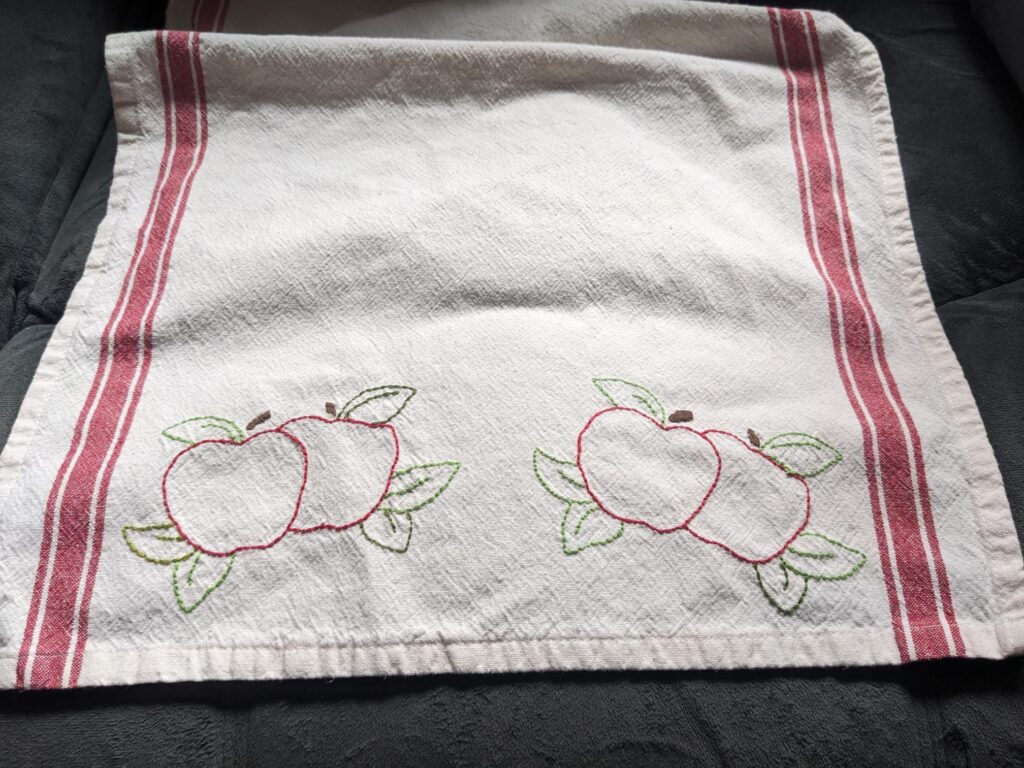
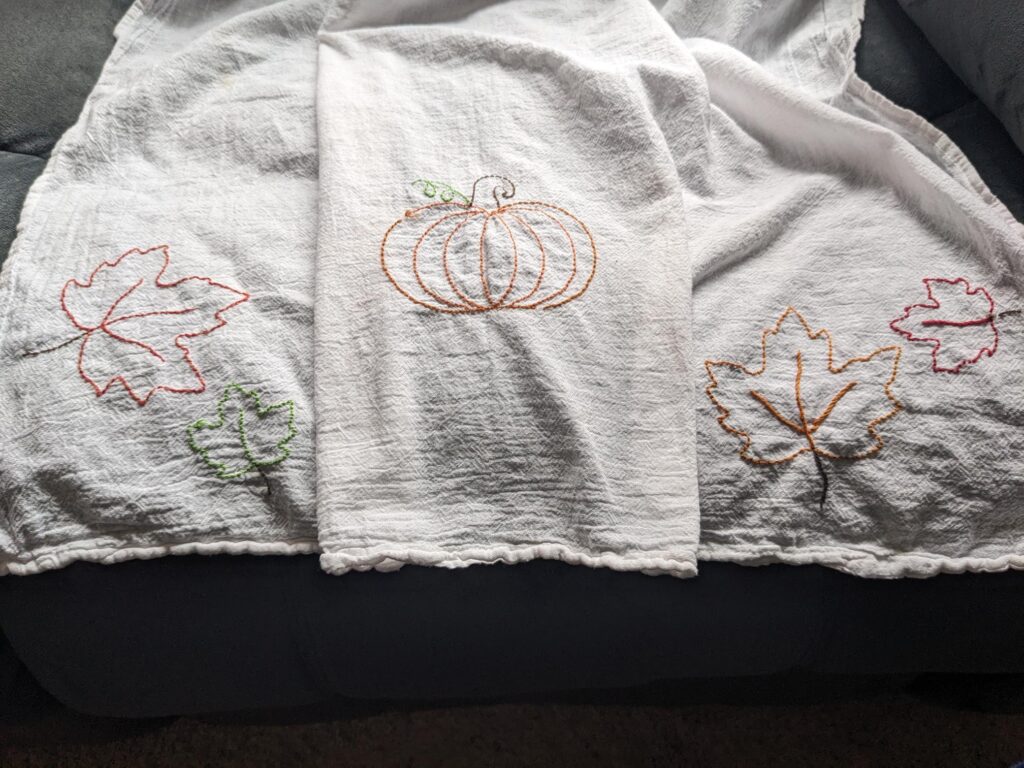
Here are a few of the towels I’ve finished:
Butterfly, dandelion and dragonflyApplesFall leaves and pumpkin
I have a few ideas for future towels, but I also need to have somewhere to use them 😉
(This post contains affiliate links which means if you purchase from my link, I will make a few cents)
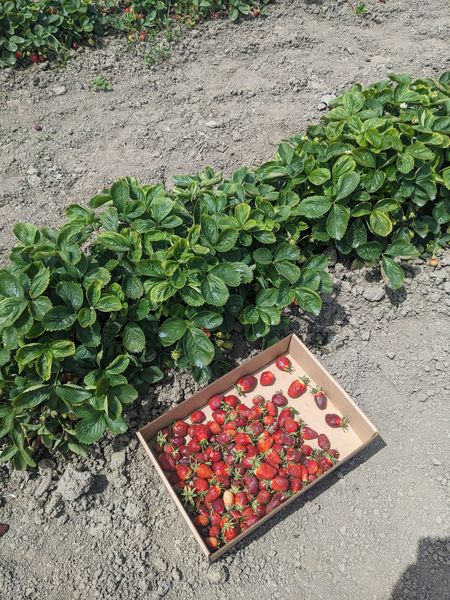
It’s strawberry season here in the PNW. I’m very thankful for a u-pick farm nearby that has a variety of things I can pick. While they aren’t certified organic, they practice clean farming practices which we appreciate.
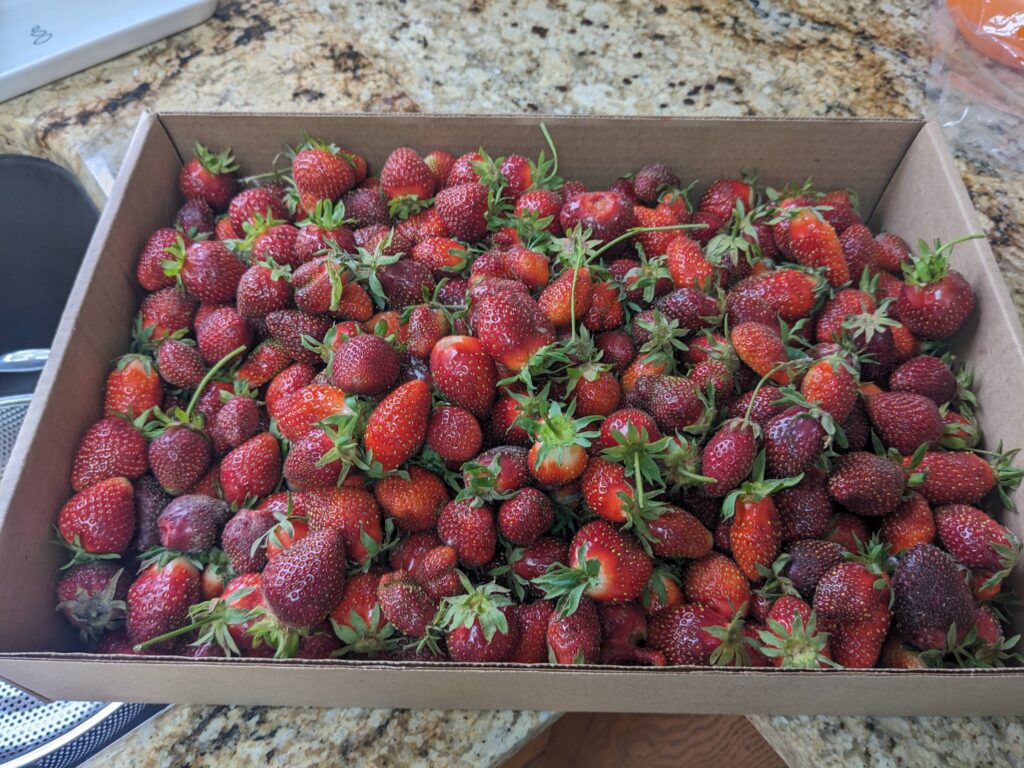
I picked about 8ish pounds and brought them home, cleaned them up, sorted them and got to thinking about all that I going to do with them.
First up, EAT them! Strawberries are do delicious. Growing up, I wouldn’t touch them! I’m so glad my tastebuds changed in adulthood, and I tried them again.
I sorted the berries and separated the ones that are the ripest. (Some are almost purple, they’re so dark red!!) We’ll eat those tonight or tomorrow morning and whatever is left of those will go into jam.
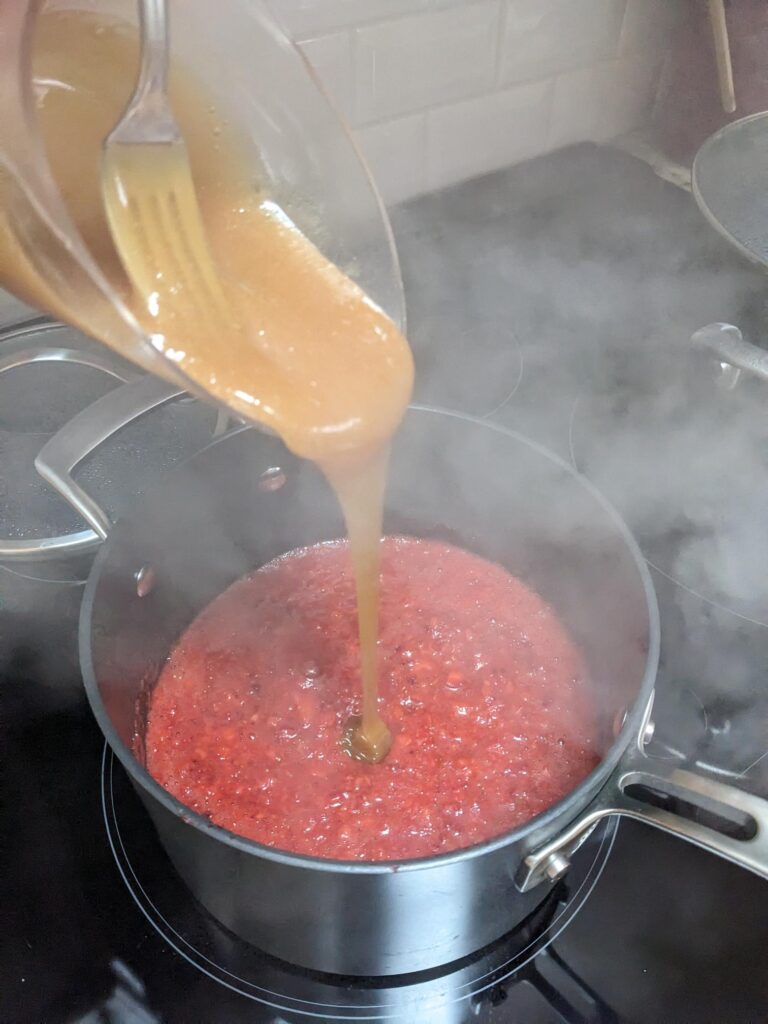
Next up, make jam! 😛 I use Pomona Pectin which is a no-sugar/low-sugar pectin and uses calcium to activate the pectin rather than sugar. I tend to use a bit of honey for just a hint of sweetness (½ cup for the whole batch of jam).
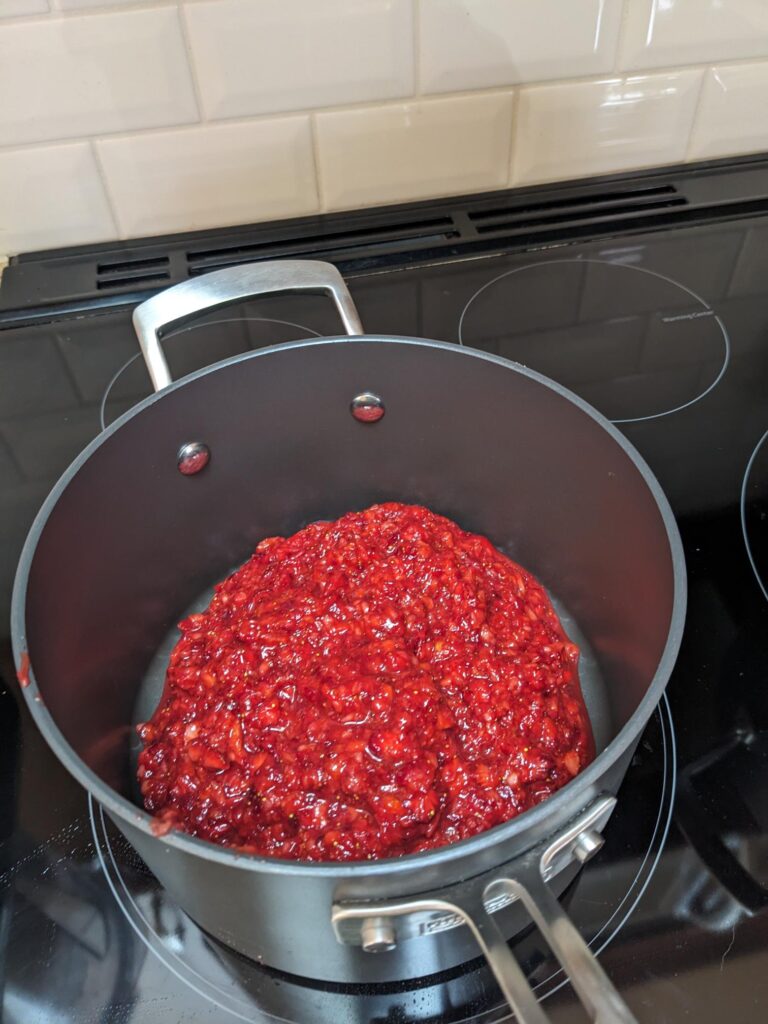
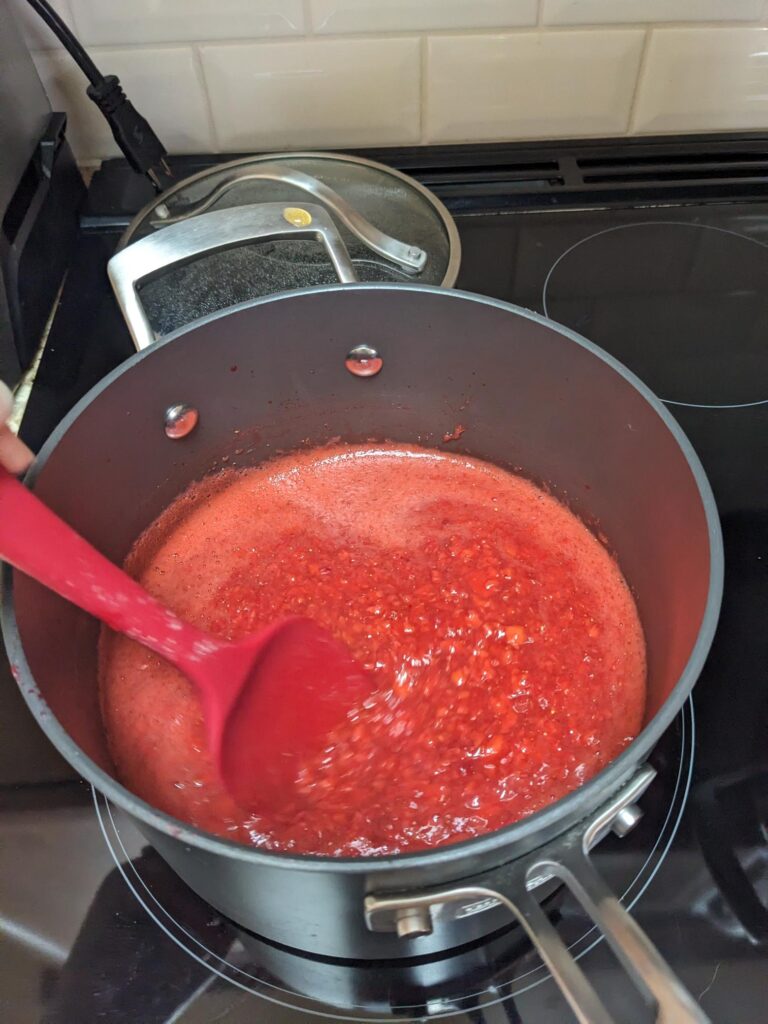
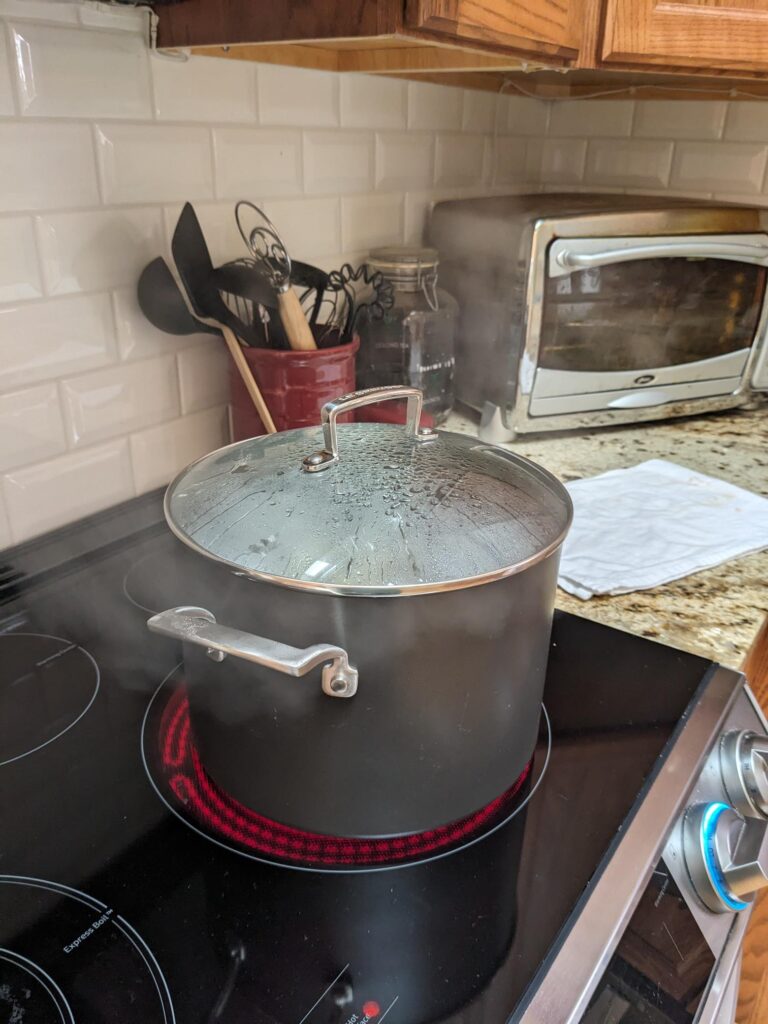
Mashed BerriesAdding honey w/pectinBringing to a boilWater Bath
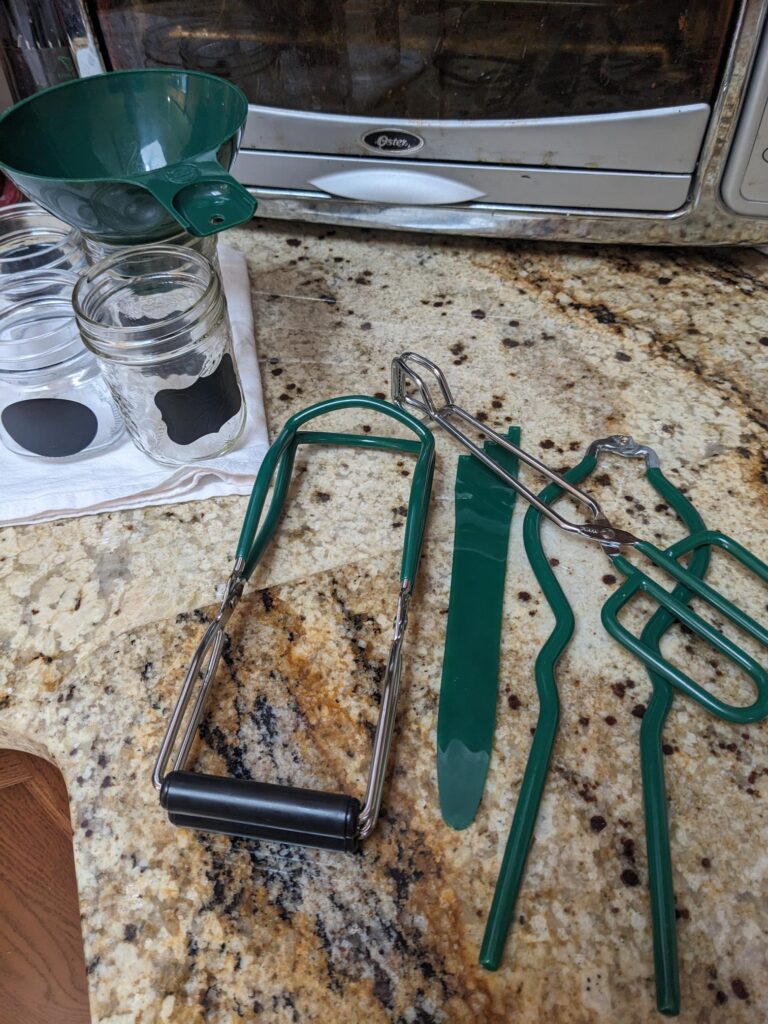
I love this set of canning tools (see picture below) which helps when it comes to not burning fingers on boiling hot items!! You’ll also need canning jars. You can buy brand new with lids & rings. Or you can buy the jars, rings and lids all separate.
Every time I can, I LOVE that ping of the jar sealing when it comes out of the water bath. I took a video and you can hear the ping, but it’s more of a ‘pong’ because the phone must have been a bit too close. LOL
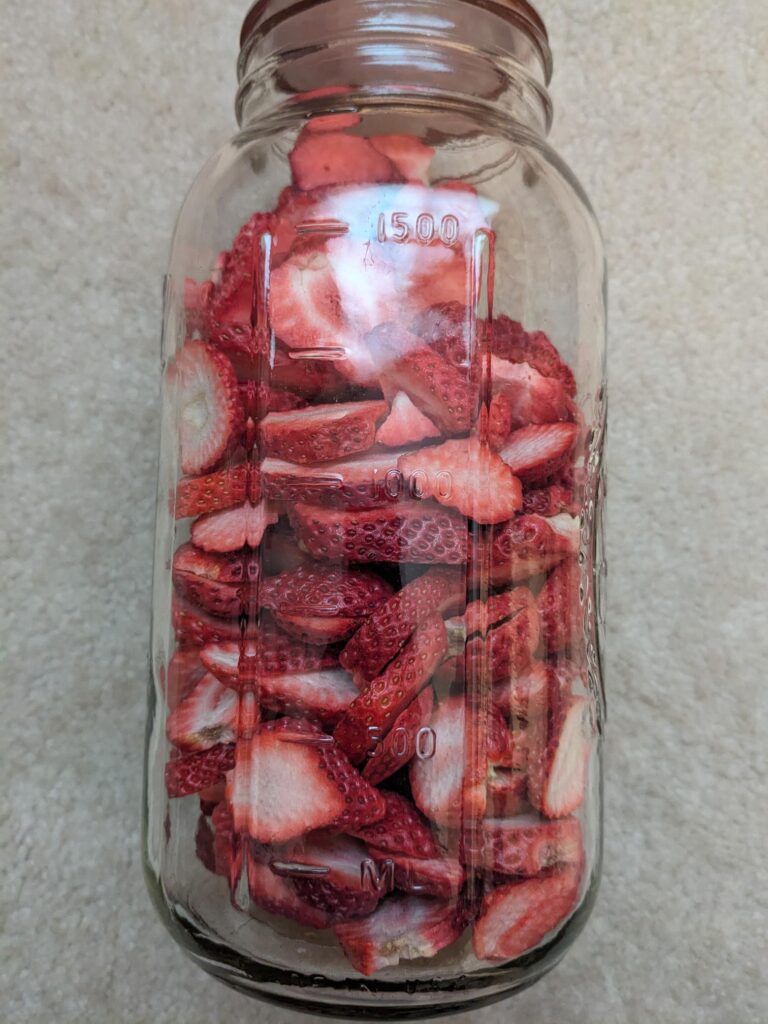
Third way to use them, freeze dry them. As I’ve previously posted, we have a Harvest Right freeze-dryer which I use to make shelf-stable, dried foods that are ultra-lightweight for backpacking. Freeze dried strawberries are delicious. They work great to break up and throw into oatmeal but are also great to eat by themselves as a snack. I love having freeze dried fruit on hand.
(I store a lot of my freeze-dried food in mason jars as I’m not doing this for long-term storage. There’s less waste with not throwing out a mylar bag every time I need to repackage something to take backpacking. I love these half-gallon mason jars! I use these jar sealers that I use with our Foodsaver accessory vacuum sealer)
Lastly, I’ll freeze some that we can use in smoothies or other things throughout the winter. (Nothing like a taste of summer in the cold of winter.) Last year, we bought a stand-up deep freeze that we keep in the garage. I have loved having fruits, vegetables and meat in the freeze to ‘shop’ from when it’s time to think about what to make for meals. I have one bag of raspberries left from last year and about a half bag of diced apples from last season.
As it is still early in strawberry season, I’m sure I’ll go out to the u-pick farm at least once more. (The farm has about 7 varieties of strawberries and only the first two were ripe when I went today.)
“Anyway, like I was sayin’, shrimp is the fruit of the sea. You can barbecue it, boil it, broil it, bake it, saute it. Dey’s uh, shrimp-kabobs, shrimp creole, shrimp gumbo. Pan fried, deep fried, stir-fried. There’s pineapple shrimp, lemon shrimp, coconut shrimp, pepper shrimp, shrimp soup, shrimp stew, shrimp salad, shrimp and potatoes, shrimp burger, shrimp sandwich. That- that’s about it.”Bubba from Forrest Gump
When someone asks what berries we have in the backyard, I suddenly feel like Bubba from Forrest Gump when I start listing out all the berries we have.
My husband loves having unique plants in the back, plus things that will flower that the hummingbirds, mason bees and other neighborhood bees can eat from. We have quite a variety in the back yard.
Before I met him, he’d walk around the backyard in the summer and have dessert. Now that I live here, I harvest the berries for us to fully enjoy through the year.
In fact, I still have 1 bag of raspberries from last year and just opened the last bag of strawberries that I picked at a nearby farm.
I love the idea of having an edible yard with a lot of things that come back every year. Seeing how my vegetables are extremely pathetic (its old seeds – at least that what’s I’m claiming), having perennial plants around help with the overall harvest.
This is the first spring that I’m paying much attention to the blossoming and ripening of the berries instead of just the harvesting!
Here is where our berries are at beginning(ish) of June!
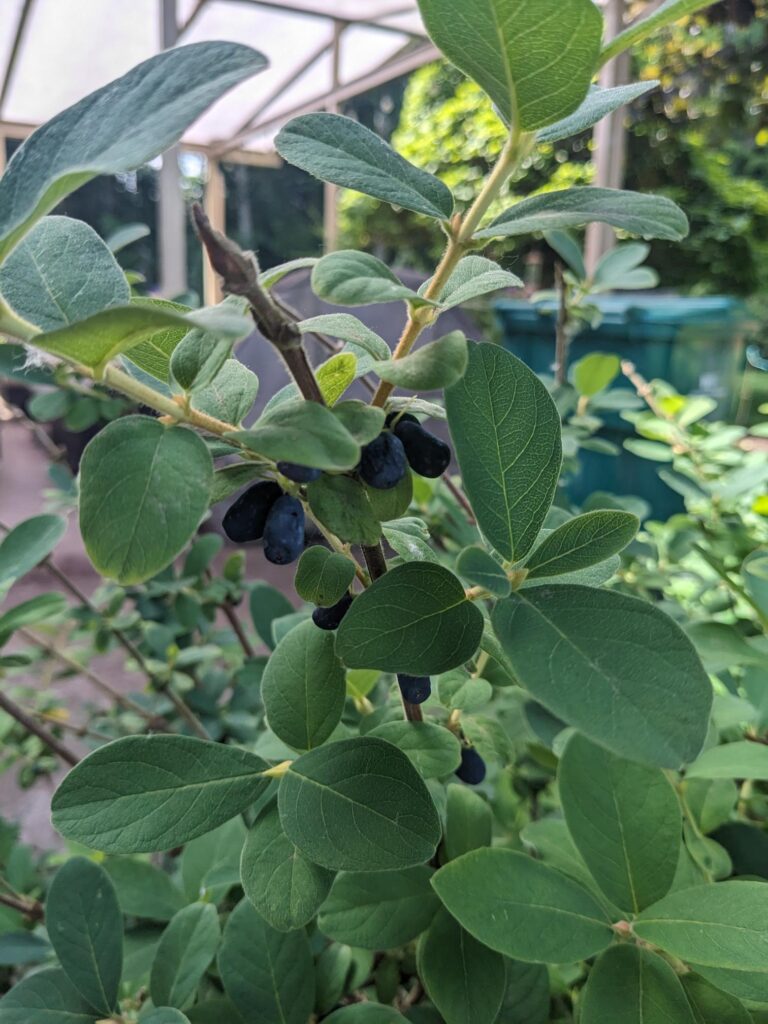
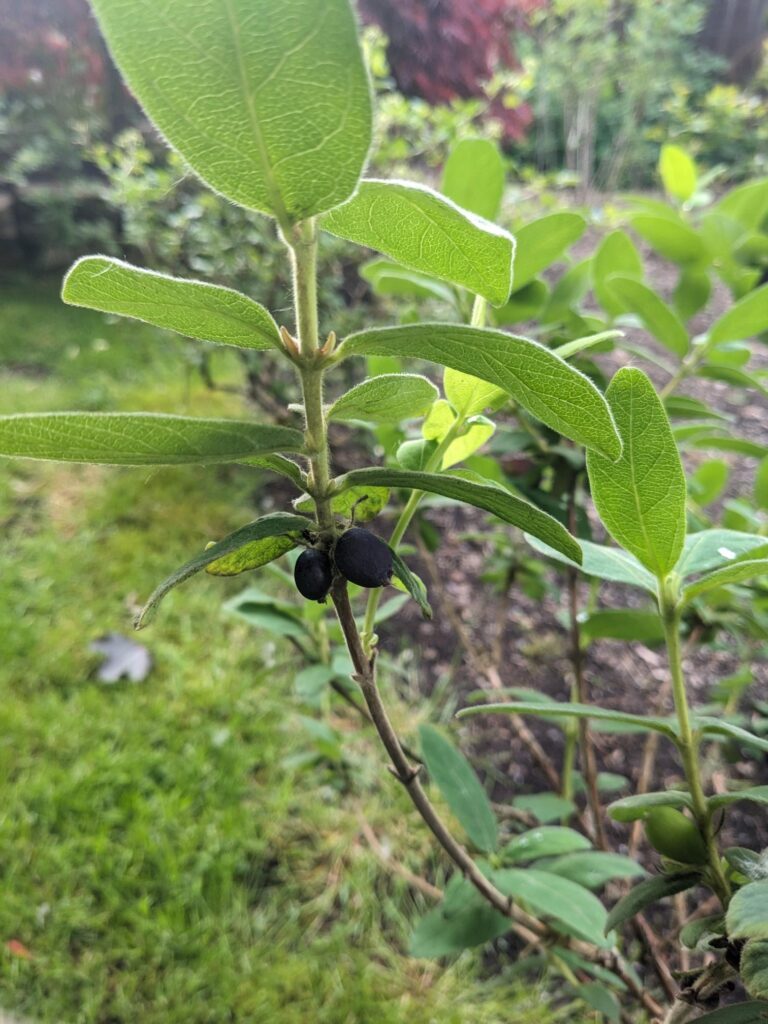
The earliest to harvest are honey berries, or haskaps.
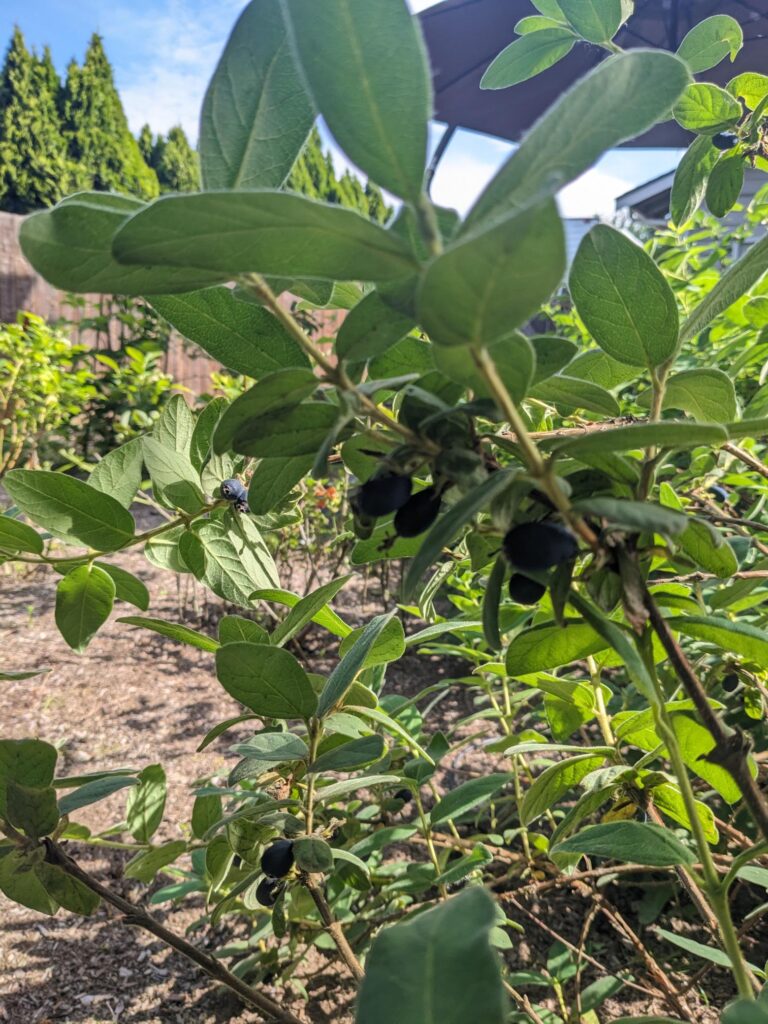
Honey berries, or haskaps, are the first to ripen in June. They grow under the leaves and look like an elongated blueberry. I find them very tart and pick them, freeze them and then throw them into smoothies over the winter. But it is fun to have something non-rhubarb to harvest early in the season.
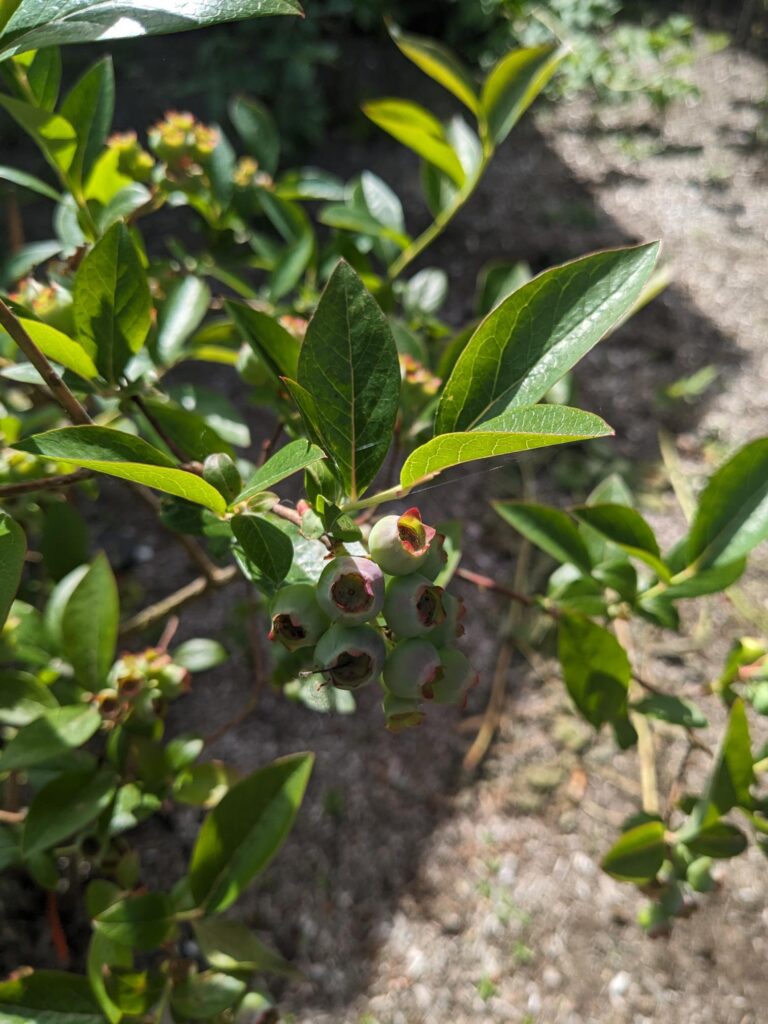
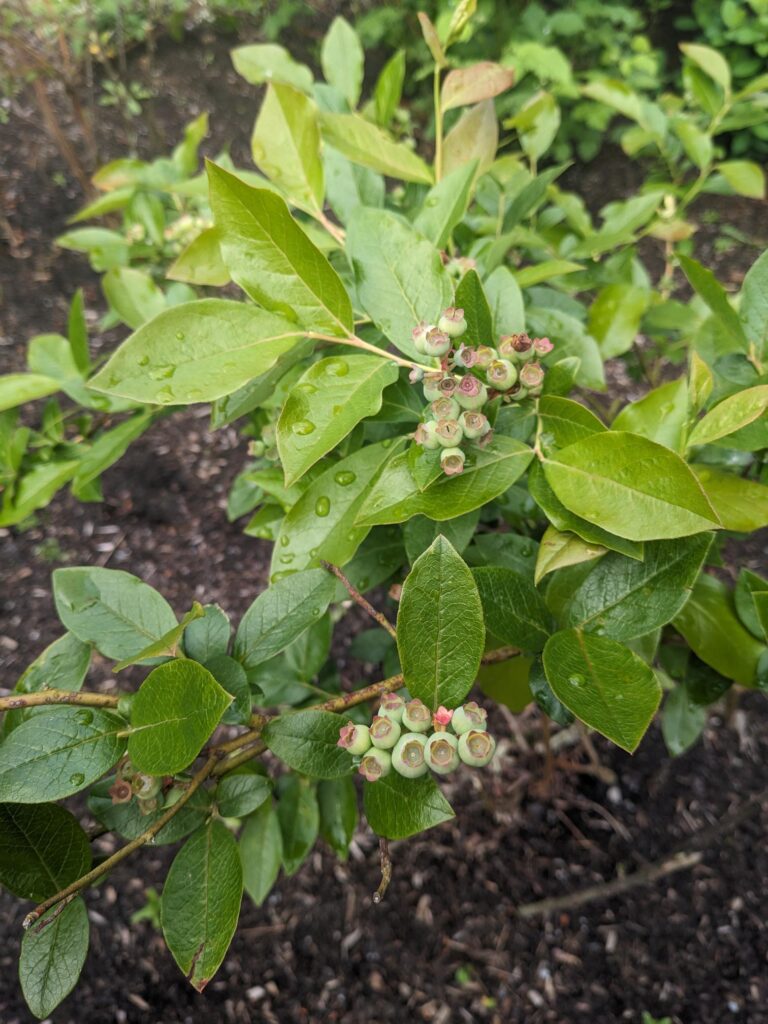
Next up are blueberries which are already starting to ripen and turn colors. (do you see that bit of pink in the picture below?)
This year, we have 2 new blueberry plants which are pink lemonade blueberries. They will be pink when ripe, so I think it may be a “by taste” test to know when they’re ripe. (that is an affiliate link)
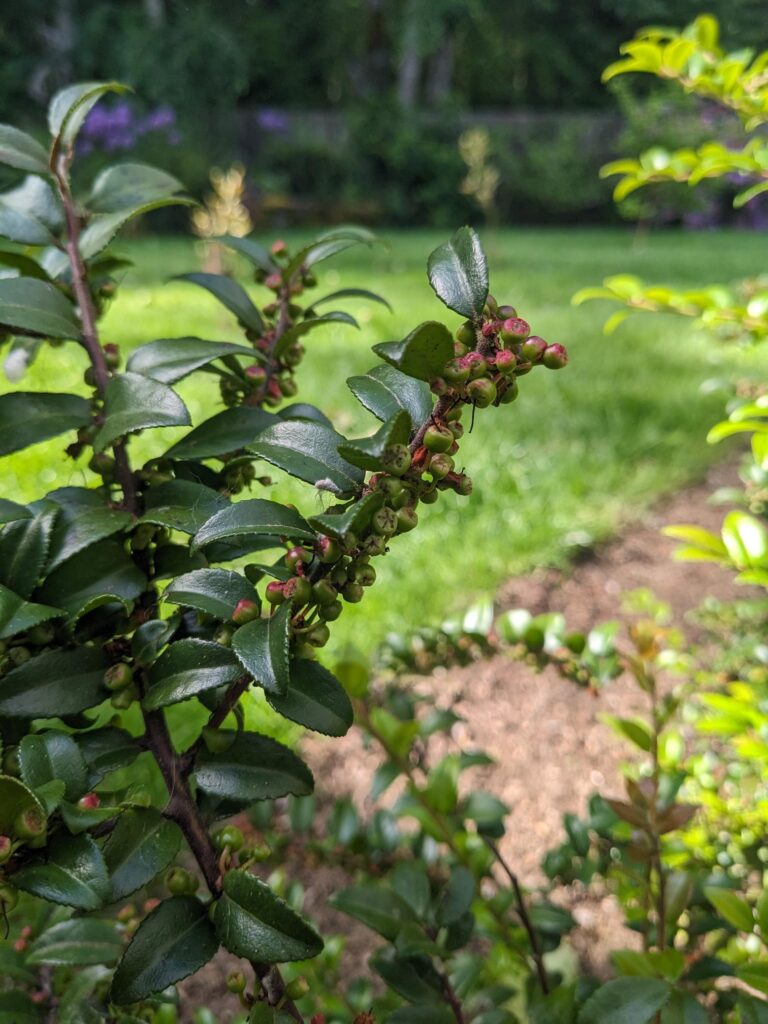
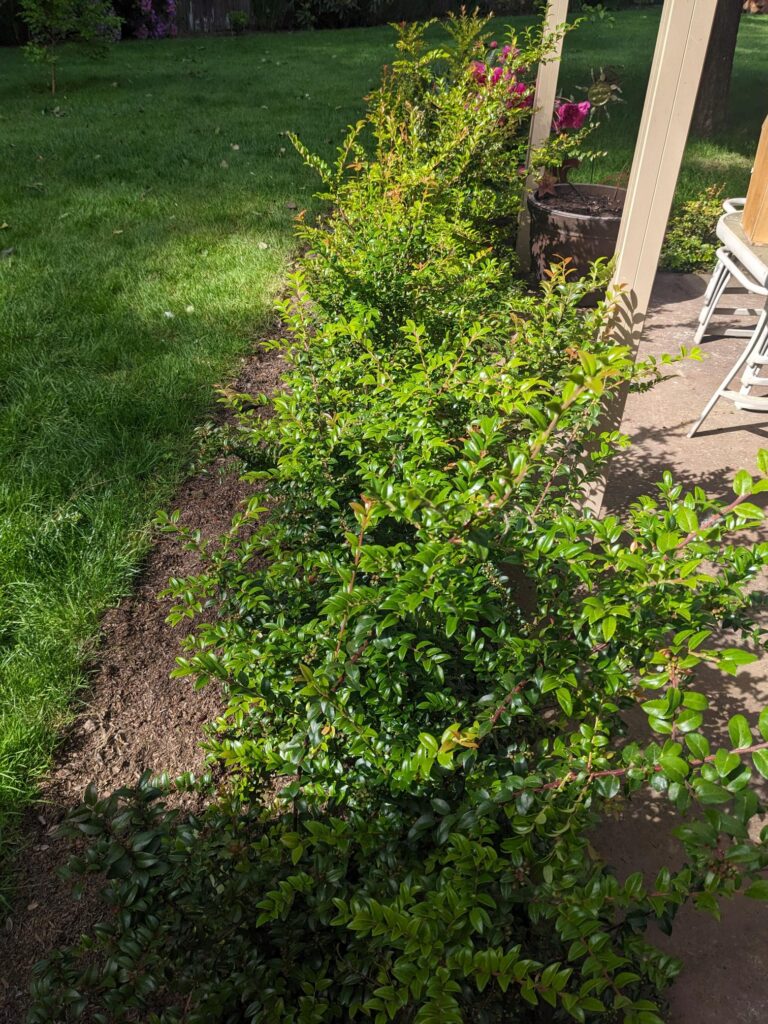
One of the fun berries we grow, but they are a bear to harvest are the evergreen huckleberries.
These are actually pretty easy to harvest, but you end up picking up a ton of debris as you do it. It’s the cleaning that is really the chore. But, these are fun tiny little berries, like miniature blueberries. I have gotten almost a gallon zip bag full the last 2 years. That leaves plenty of berries on the plants for the birds to pick at too!
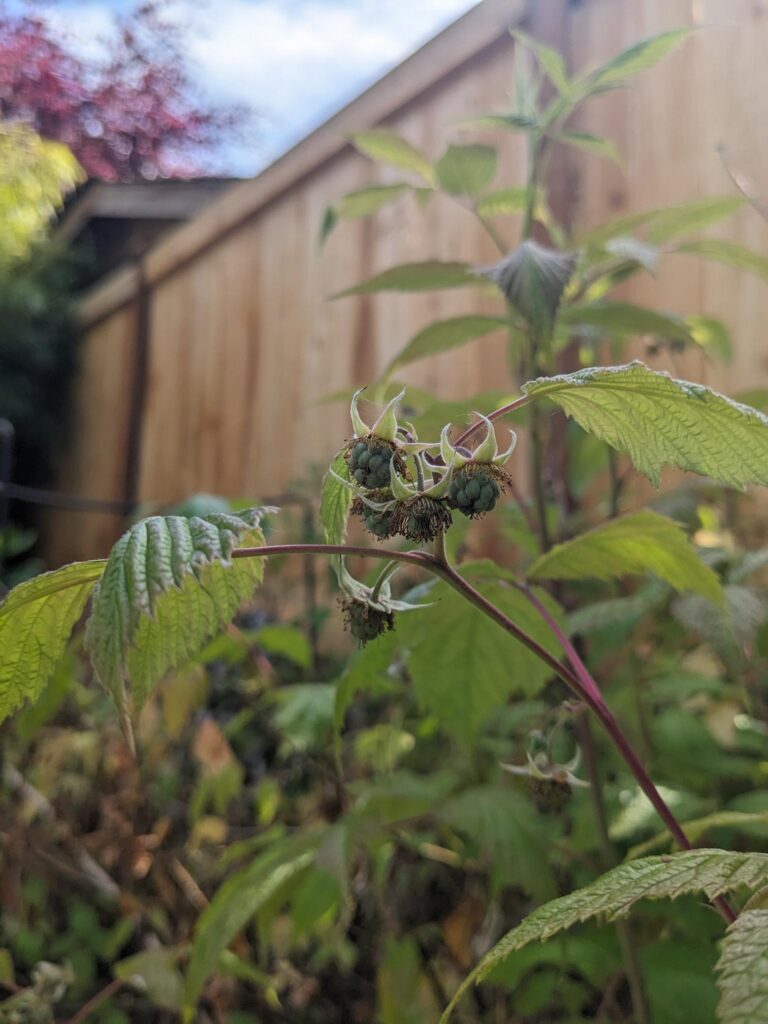
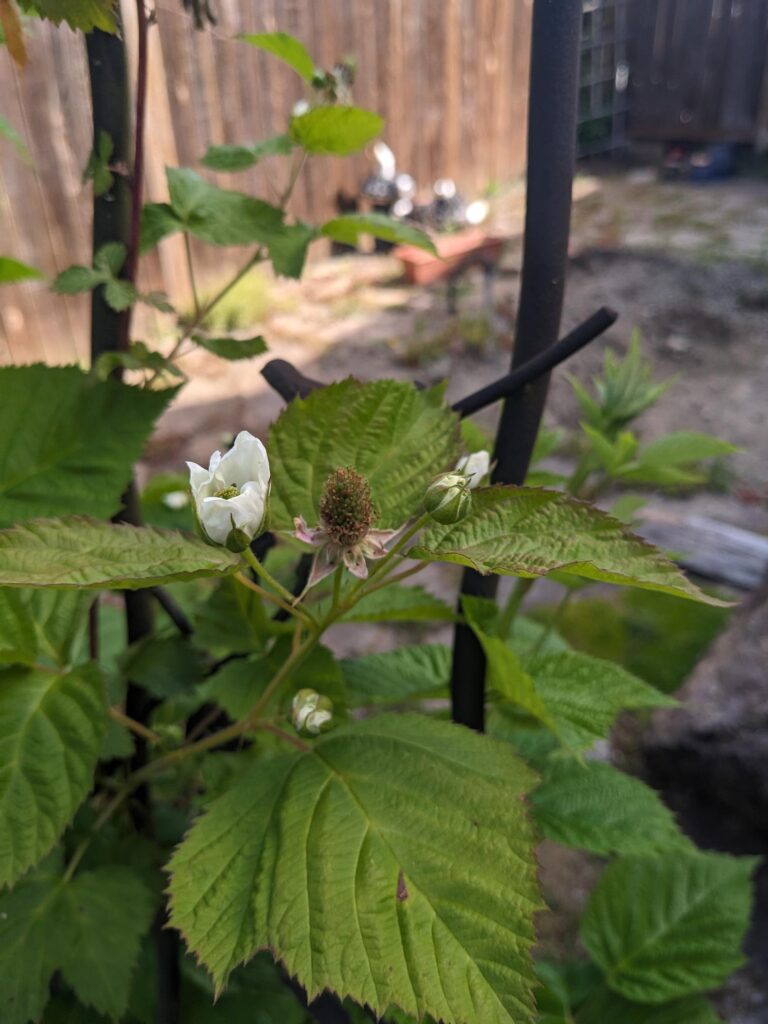
We are in the second year of transplanted ever-bearing raspberries. I pruned them back in the early spring just as leaves were starting and pulled out all the canes that weren’t growing any. Ever-bearing will produce a spring AND a fall crop (first year canes vs. second year canes). After the second-year canes produce, those canes have finished their lifecycle.
You can see the berries starting to grow from where the blossoms were. They’re so cute!
I love strawberries (as an adult). Growing up, my parents had a small u-pick strawberry patch, so of course I had to help pick berries. At the time, I hated strawberries. Boy am I glad my tastebuds changed with age!
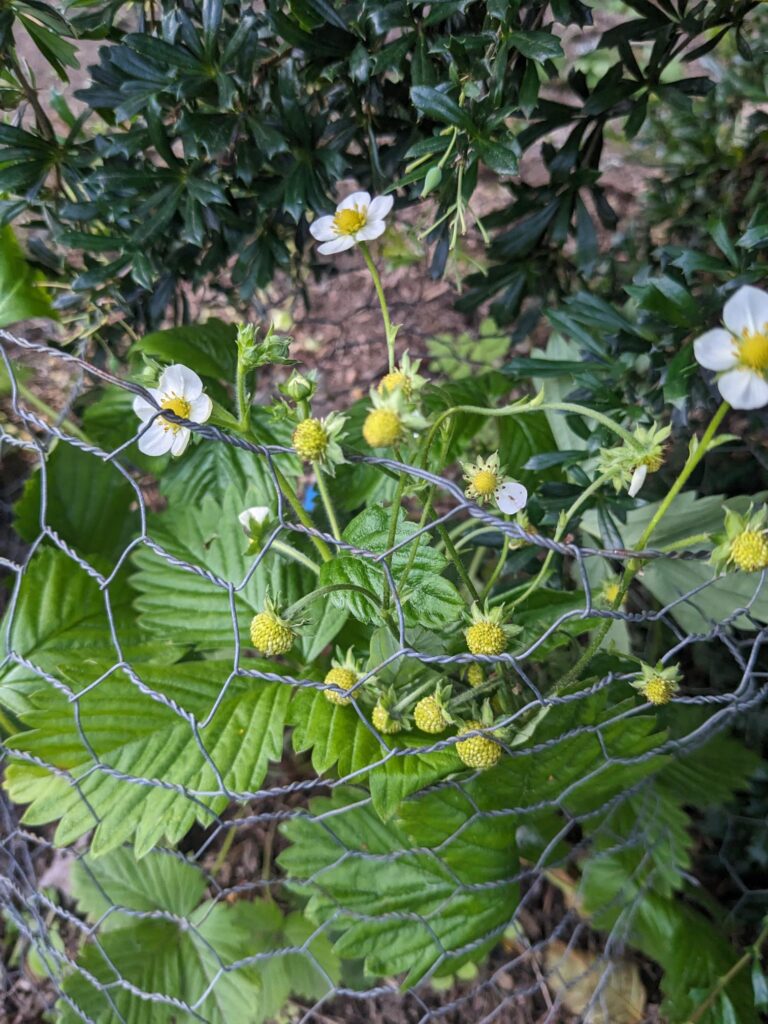
I have a spot in the yard that is fairly shaded, so we have planted alpine strawberry varieties (mignonette). They’re fairly novel and oh so tiny, but I’m looking forward to eating the couple of tiny berries these will produce. (that’s an affiliate link)
(They are surrounded by chicken wire to keep the bunnies out!)
One of the berries that I’m surprised at how much I like are boysenberries. Think huge, long blackberries!!! I made jam with them last year, both by itself and in a triple berry blend. I also threw them in a bag in the freezer as I harvested them (at least the ones my husband didn’t eat right as I brought them inside) along with tayberries & loganberries for a mixed berry blend. (affiliate link above)
We have several other kinds not listed or shown. “We have blueberries, blackberries, raspberries, boysenberries, honey berries, tayberries, logan berries, goji berries, lingonberries, huckleberries, strawberries. That’s all I have to say about that!” ~Little Susie Homemaker
Rhubarb causes so much excitement because it’s the first thing to harvest in the spring which means it is almost the start of gardening season. (Here in the Pacific Northwest, that season starts late and ends quick!!!)
I also hate rhubarb – what in the world do I do with it all????
Rhubarb isn’t one of those veggies that you just take a big ole stick and munch on all day. There’s the usual Strawberry Rhubarb pie, jam, scones, cakes, etc., rhubarb sauce (think applesauce but with rhubarb) and……what else????
Last year, I made strawberry rhubarb jam. It’s yummy, but it turned out to be my least favorite of the jams I made, and the color is rather unappetizing. (Strawberries lose their color when you cook them, so the jam is a lovely shade of…brown.) I still have 2 small jars of it left from last year.
Earlier this spring, while visiting a garden shop, I saw a jar labeled Raspberry Rhubarb Jam. Lightbulb moment!!! I have frozen raspberries that were given to me. And I have frozen rhubarb that I harvested and had no idea what to do with.
The other day, while my husband was out mountain biking, (I tend to my messiest kitchen stuff while he’s not home) I decided it was the day to make the jam.
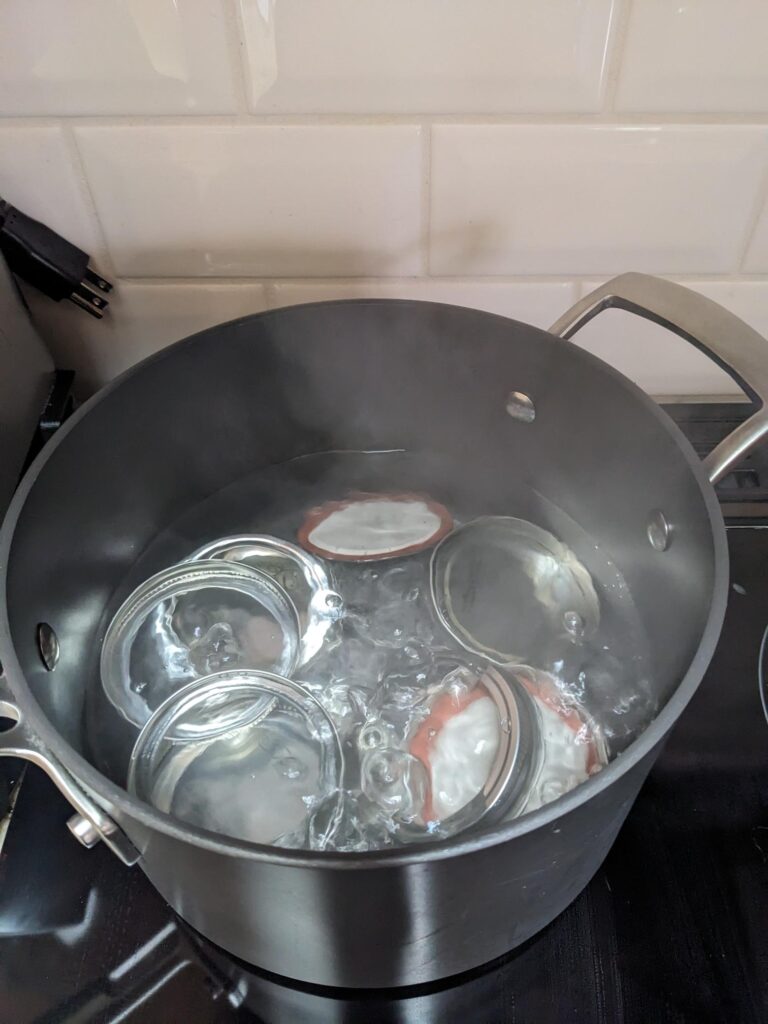
Out came lots of pots and pans – the pot to cook the jam in, the pot to put jars in hot water while they were waiting and another pan to put the rings & lids in to boil while the jam was doing its thing. (Oh, I was also making a batch of pancakes for the freezer at the same time – the kitchen was A MESS!!!)
Last year, I found Pomona Pectin which is a no/low sugar pectin that uses calcium and pectin to gel jams. (that is an affiliate link) I still use some honey in my jams, but no sugar! (I used 1 cup of honey for a double batch.)
*Interesting tid bit – do you know the difference between jam and jelly? (I’ll tell you below)
I followed the raspberry recipe in the pamphlet inside the Pomona Pectin box and doubled it. (Their recipe calls for 4 cups of berries and since I had both berries and rhubarb and 4 cups of each, I doubled the rest of the recipe)
I put the berries, rhubarb and calcium water into the pan and then mixed the pectin with the honey. I brought the fruit to a boil and then stirred in the honey and brought it all to a boil again.
Time to fill the jars. I pulled the jars out of their hot water bath and put them on a towel on the counter (hot jars, cold granite counter – towels help!!).
I ladled jam into the 6 jars I had out. The handy-dandy funnel helps keep things much cleaner. You need very clean jar edges to ensure a good seal and the funnel helps keep those edges clean. (That funnel comes in this canning set which is fantastic and helpful when dealing with VERY hot jars, contents, lids and rings!) (that is an affiliate link)
The jam was now ready to get its water bath. Since I only had 5 full jelly jars (the 6th was only partial so I didn’t ‘can’ it, it went in the fridge to use right away), I cleaned out the pot I had made the jelly in, filled it with water, and brought that to a boil. Once it was boiling, the jars went in to boil for 10 minutes. (Please use proper canning procedure to ensure you don’t have spoilage. Ball has a great book on canning basics that is a fantastic resource to have on hand.)
*tid bit – jam is made using the whole fruit, jelly is made using just the fruit juice
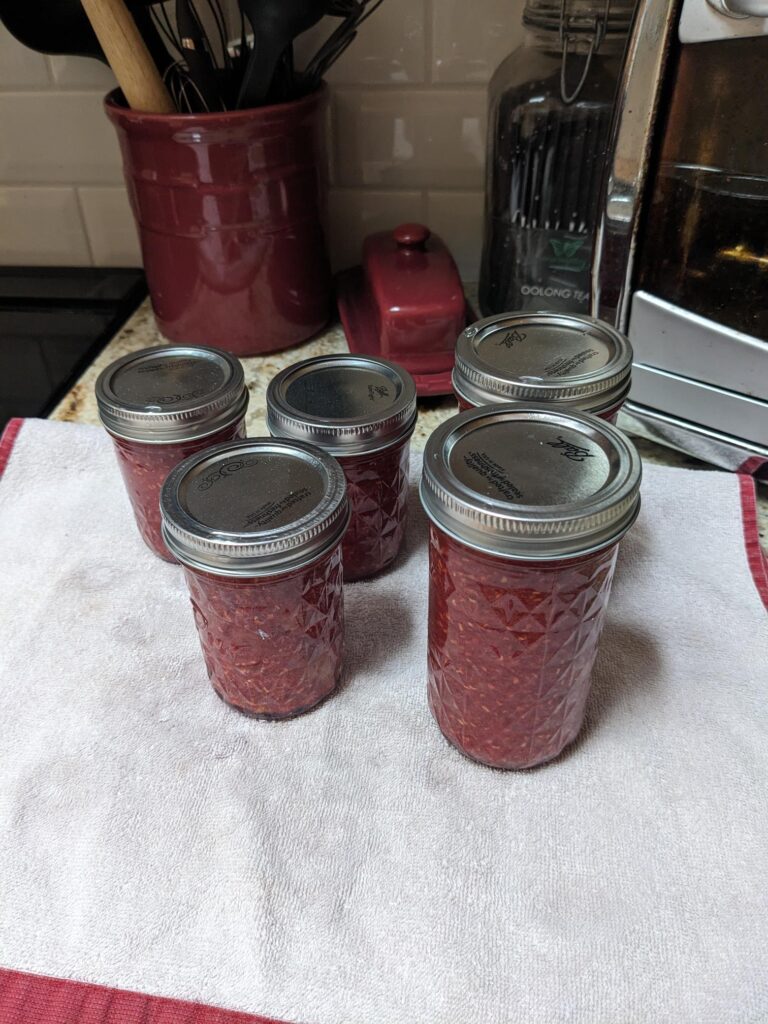
When they finished their bath, they dried off on the towel on the counter. (again, hot jars, cold counter, good idea to have something to buffer between the two.) And I waited (not for very long) for that satisfying ‘ping’ that lids make when they seal. The first ping was before all of the jars were out of the pot!
awaiting the ‘ping’
I let the jars cool for a good 9+ hours before I moved them. I wanted to ensure everything was sealed well.
After making the jam in the morning, I made a loaf of sourdough bread that evening and then had a slice of bread with the jam for lunch today. YUM!!! I think strawberry rhubarb is something in the past for my tastebuds. The raspberry rhubarb combo is DELICIOUS!!!
I know I already posted about the garden for the month of May, but I find myself walking around the backyard multiple times a day just to gaze at the dirt.
There is something so satisfying about watching things grow.
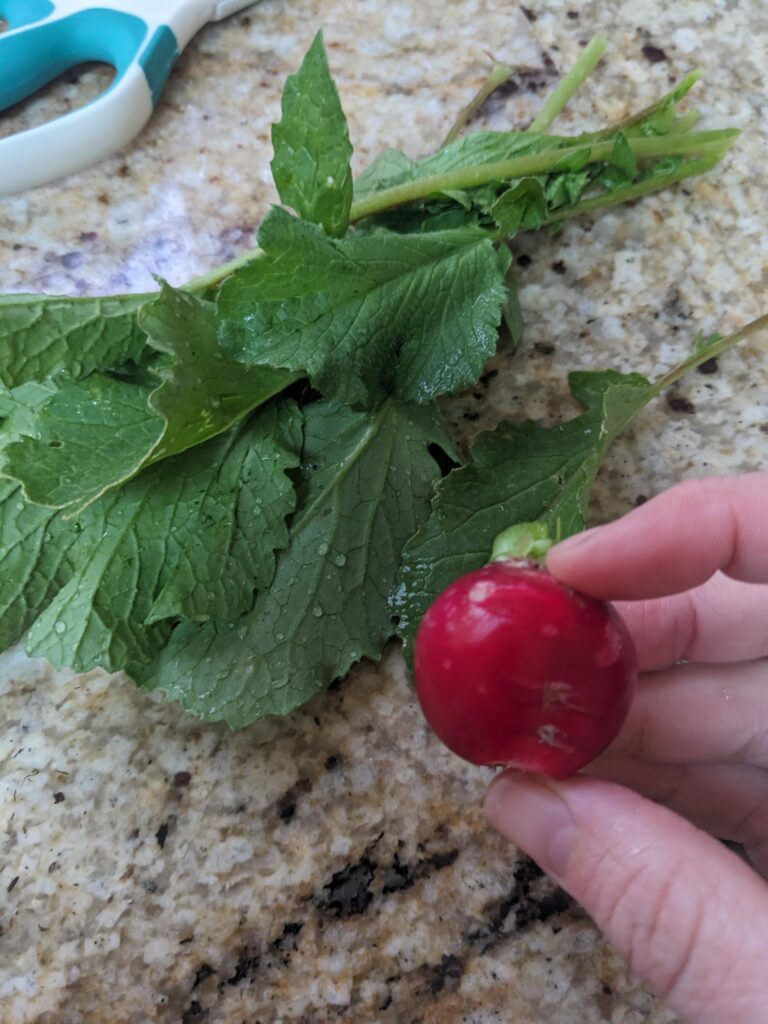
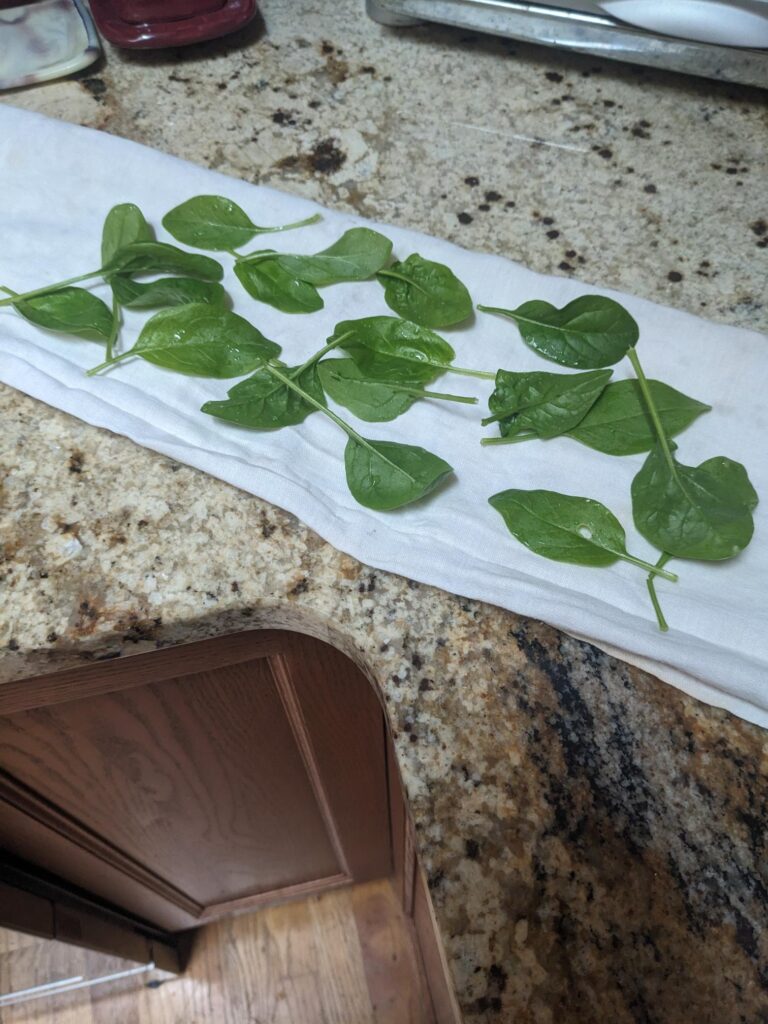
I have harvested rhubarb, radishes and spinach so far. The rhubarb is excelling! If only I could excel in how to use it all up!
First RadishFirst Spinach Harvest
I have 4+ cups frozen ready to do a batch of raspberry rhubarb jam. I only hesitate because I still have jam left from last season and the strawberry rhubarb is my least favorite flavor. But, I’ve never had (or made) raspberry rhubarb so I’ll give it a try.
I also have 4+ cups of frozen raspberries that were given to me, and they were already frozen solid. I figure this is a great way to use up both items!
The radishes are coming in well, but so far, the ones I’ve picked have all been split. At first I thought something was eating them, but once harvested, I realized they were split and not bites out of them. I’m also finding that they don’t keep. I’ll need to look into how to keep them, although I’m harvesting 1-2 every few days, so really should just eat them right away.
Spinach has been planted in 2 different places. I’ve done multiple plantings in both spots, but so far they’re only so-so in how it’s coming in. The larger garden area seems to not be very hospitable to spinach.
One of the spinaches looked like it was growing a seed pod, so I snipped that off the top before it bolted. (No idea how it could bolt as we haven’t had much heat yet)
One of the biggest hurdles to the garden (at least I’m blaming it on this and NOT on my own skills) is that we’ve had old seeds that I’m using up. I decided that was a major issue and decided to go ahead and throw seeds onto the garden just to see what will take.
There were several packets of miscellaneous ‘greens’ that I figured we wouldn’t actually eat so I threw them into an open area along the back fence that the bunnies can have their fill (if the seeds actually grow something). So far, I’m seeing two areas that seem to be growing. If that will keep the bunnies away from the other things growing, it will accomplish what I hoped it would.
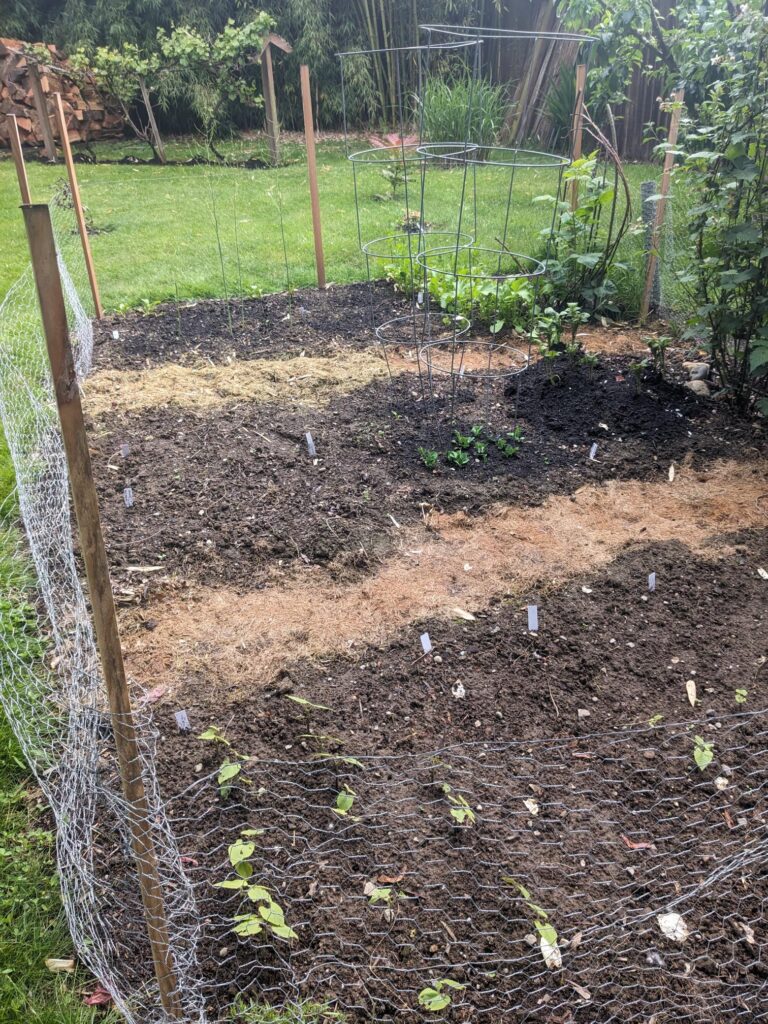
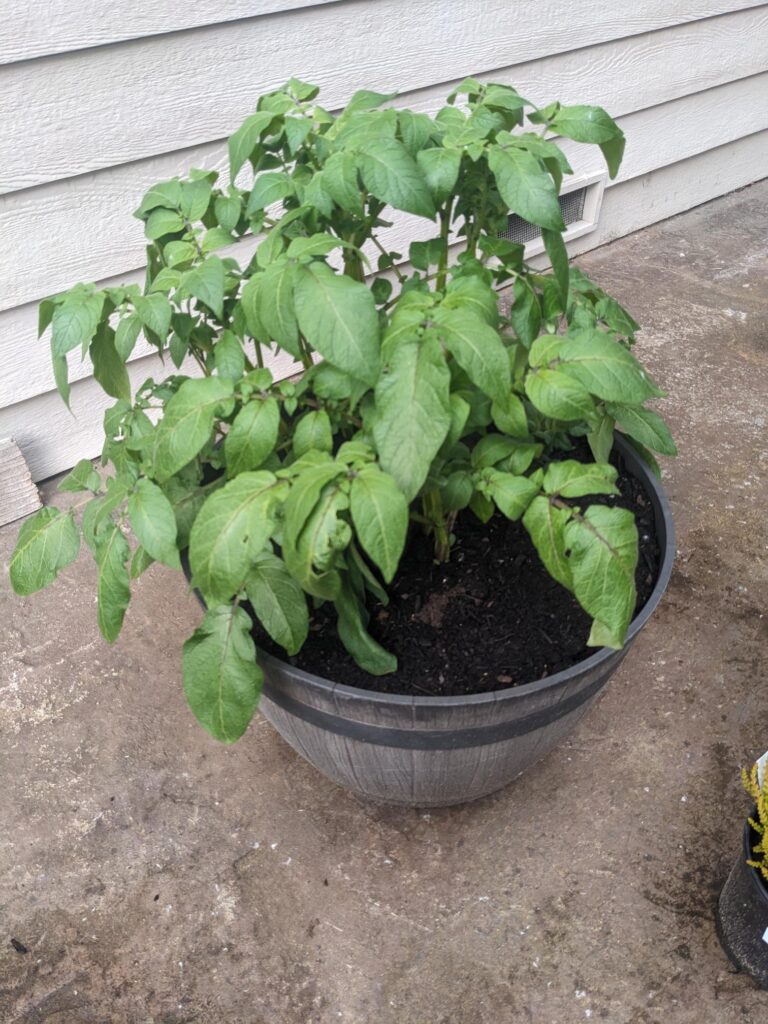
In the main garden, there are 6 bush beans that have sprouted. And 3 rows of black beans have sprouted! The potatoes have come up and I’ve added more soil on top of the greens, and they’re working their way up over that additional soil. The peas planted under the tomato cages are coming up on one side. And it looks like there might be broccoli and cauliflower coming up next to the potatoes (time will tell).
Top row (L to R): Spinach, Asparagus, Beets (not growing), Radishes Middle row (L to R): onions and carrots (not growing), peas, potatoes and possibly broccoli & cauliflower on the edges of the potatoes Bottom row: black beans (3 rows), bush beans (3 whole sprouts :o) and not seen, 2 rosemary bushes on the cornersPotatoes in the pot! They are loving this pot. I’m excited to harvest this fall!
The honey berries are starting to turn purple and ripen. These are the first berries to ripen and they’re quick to ripen. (Kind of like an avocado – “I’m ready!!!!” 30 seconds later, “sorry, now I’m over ripe. You missed it.”)
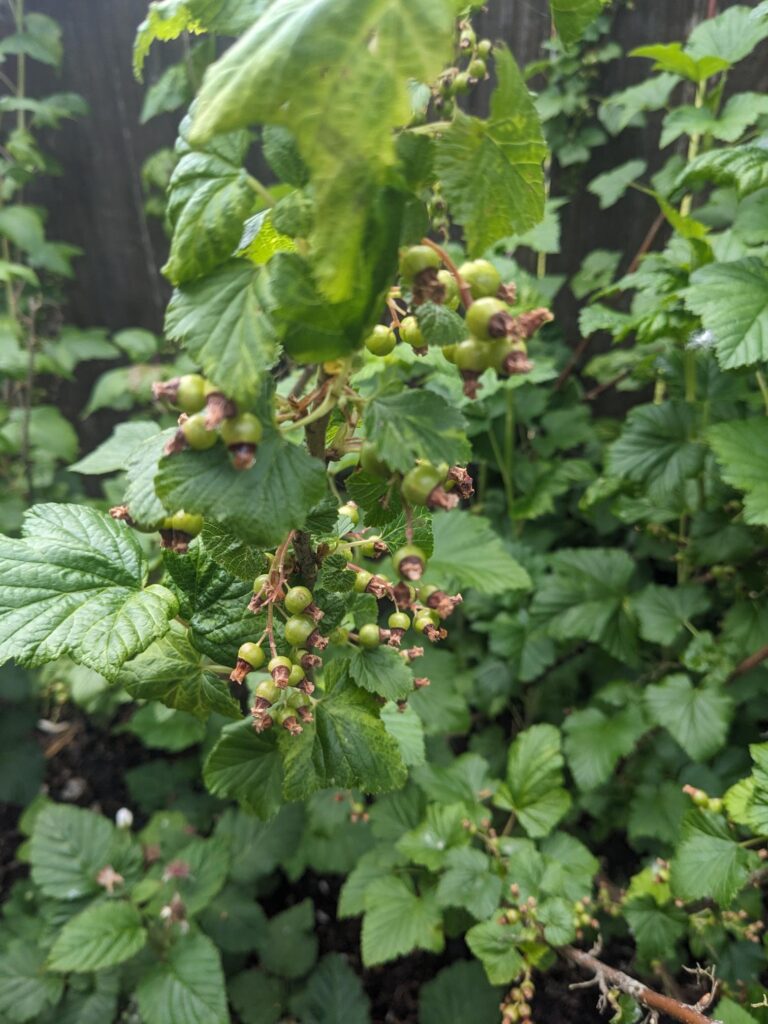
BlueberriesCurrantsHoneyberries
Blueberries, currants, huckleberries, gooseberries and raspberries all seem to be coming in strong. Little green berries are growing, and blossoms are falling off. Thank you, bees!!
Looking forward to what June bring!
Garden Tally as of 5/26/24: 7.78 lbs harvested (thank you rhubarb!)
*links in this post are affiliate links which means that I may make a bit of money if purchased through my link
For anyone who is frugal, I’m sure that making things for yourself from scratch is high on your list. It is for me!!
I decided that after I retired, I would delve into the world of sourdough because it seemed VERY intimidating and time consuming. I’m glad I did it! I’m also glad I did it after I retired and had plenty of time. I know myself well enough to know that I would have thrown in the towel if I had tried it while still working and focused on other things.
I won’t get into the all the crazy info that is available about sourdough, but I will say that it has been a journey. Early loaves were either gummy or so hard you couldn’t bite into the bread. Some were so dry, you had to drink a gallon of water to get through half a sandwich. And some were VERY crumbly and wouldn’t hold together for much of a sandwich.
I’ve been making sourdough for almost a year now and my husband said the other day “These latest loaves are really good. I’m really glad you didn’t give up on this!”
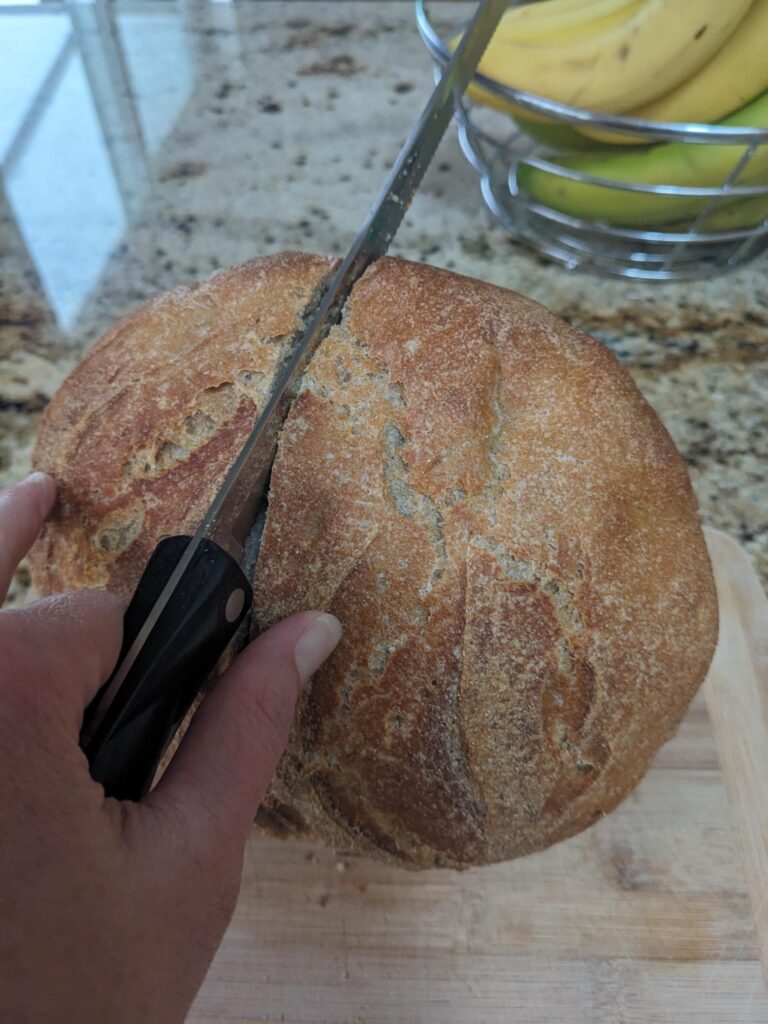
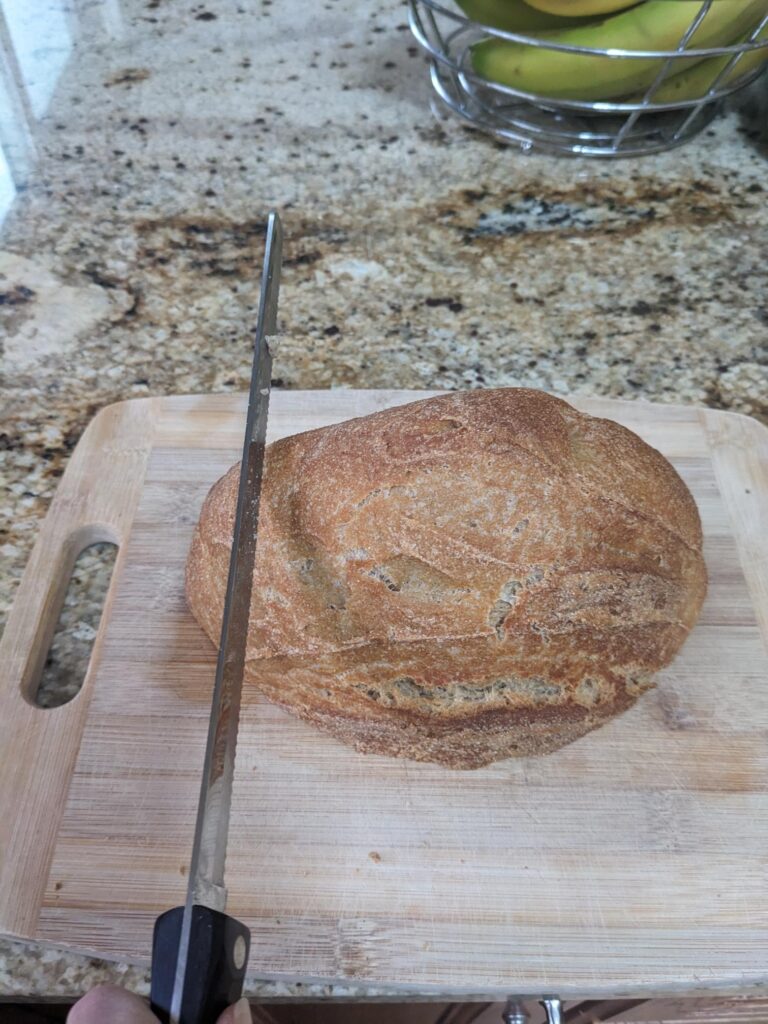
Cut bread in half
Me too!!
One of the most frustrating parts of sourdough for me has been getting it cut in thin enough slices that I could actually eat it as sandwich bread.
I’ve used various bread knives, asked for a slicing set (knife included) for Christmas but returned it and have finally settled on what works for me!! Bread knives are a mixed bag for sure. They either work for a slice or two, or they completely squish the bread in order to even start the cut.
When I visited my parents earlier this year, my mom had asked me to make sourdough while I was there. I was happy to, but was even happier to discover the knife that makes sourdough slicing a joy!
A CutCo Bread Knife makes it so easy!!! My parents have used CutCo knives for years and look for them at garage sales or estate sales because they are such good quality and have a great warranty.
I used their knife while at their house. Then promptly found one (on Facebook marketplace for half of what is it on Amazon) and bought it!
I can now slice my bread into thin slices that make eating sandwiches with my homemade bread so much easier to eat!
Here is my method of slicing my sourdough that now works perfectly with this CutCo knife!
Cut your round loaf in half (see photo above).
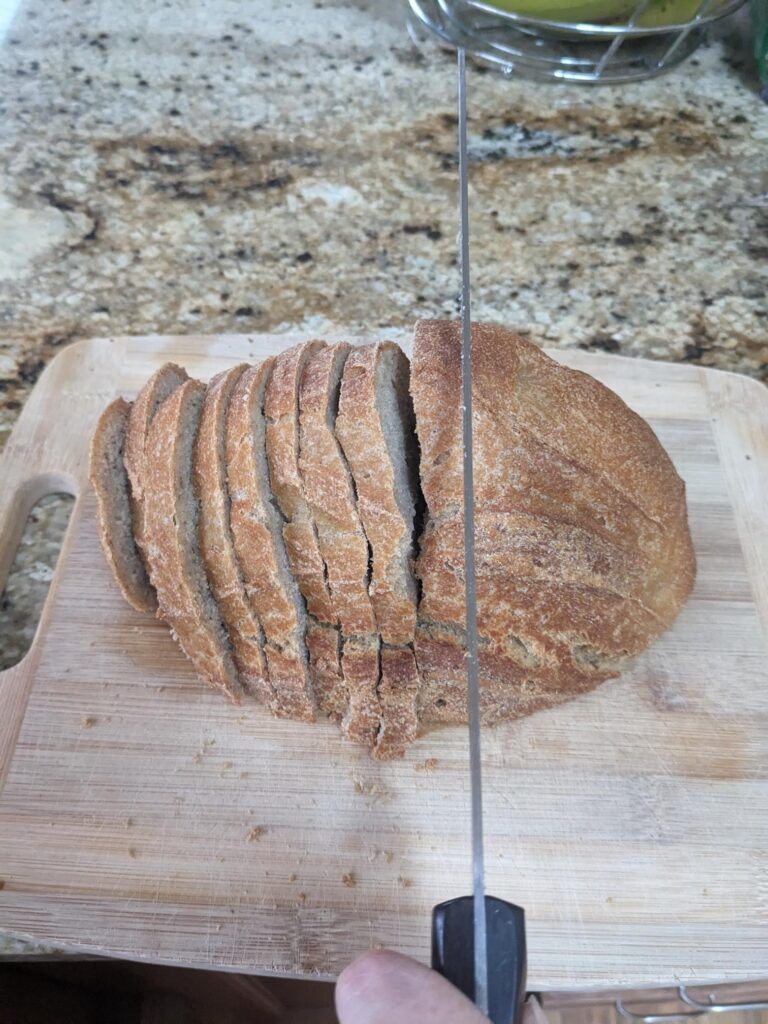
Put cut side down on the cutting board and begin slicing to the desired width you want.
Cut second half the same way as step #2.
Cut side downSlice to desired width
Viola, you have a sliced loaf of sourdough bread!
Since its just my husband and I eating this and it dries out in a day or two, I put 3/4 of the loaf in the freezer (already sliced) and take out a few slices as we need it. It thaws to the softness and crustiness of baking day (or the day after). Once I have it on the counter, I have it stored in a cotton bag that I have melted some beeswax on it help keep it fresh. (Experience showed that plastic isn’t a good way to store sourdough).
There you have it, scratch sandwich bread without squished, wonky sized slices of bread!
Here is chapter 3 from our trip to Southern Utah last month. If you missed the other chapters, read them here and here.
Arches National Park is located just outside Moab, UT. It has become a ‘timed entry permit required’ park. Like so many national parks, it became overrun and extremely busy and they implemented timed-entry. I will say it made it for an extremely pleasant visit.
We had 7AM permits and drove in about 7:50am. (You have an hour to enter with your permit – if your permit is 2PM, you will have from 2-2:59PM to enter the park.) We were able to enter quickly, stop at the visitor center and fill up with water and use bathrooms.
We headed into the first stop having by-passed a couple of turnoffs. The Windows Arch is actually several arches all in a small area and you can do about a mile walk if you want to do it. (North Window, South Window and Turret Arch.)
North Window Arch
Some of our friends saw a snake, so there are definitely rattlesnakes in the area, but I (thankfully) didn’t see or hear any!
We walked around the corner to see South Window Arch and then over to Turret Arch. All of these are within the same parking lot. Enjoy the beauty!
Double Arch
Across the parking lot, down a short trail past the toilets, is another short trail to see Double Arch.
We climbed up in there and explored around. The rocks look steep but are easy to climb if you have decent traction on your shoes.
We then drove down the road to Delicate Arch!
Delicate Arch
This is a tough 3ish mile hike up to see this arch. There are viewpoints down below that you can drive to, but we didn’t go to those. As tough as it was to get to, it was worth the effort. I struggled because it was day 8 of a hiking trip and my stamina was waning by that point.
You may recognize this arch if you’ve ever seen a UT license plate. This is the arch featured for the state. It’s pretty iconic!!
Most of the trail up was on slickrock (which isn’t slick when dry!!) and easy to walk around. If you’re afraid of heights, this may be a decent test of your resolve.
This trail is very exposed, so make sure you have water with you and are wearing proper sun gear.
Final stop on this day was at the end of the road. The group went out to Landscape Arch, but I stayed in the car and snoozed. I was exhausted by this point. Mr. LSH & I plan to go back to this area in the future, so I know I’ll get to see Landscape Arch another time.
Fiery Furnace
The next day, we went back to the Fiery Furnace. Permits are required. Permits are available at 8AM MT the week prior to going. If you intend to go on Wednesday, then log into the recreation.gov site early the Wednesday prior to get permits.
We picked up the permits the day before at the visitor center and watched the required video. We spoke with the ranger before heading who had some really great information. They allow 75 people total per day which makes it a wonderful experience to be able to explore without constantly running into masses of people.
View coming out of the Fiery Furnace
The Fiery Furnace is a rock playground. You’re allowed to explore anywhere in this area as long as you stay in a sandy wash or on rock. There are delicate areas that you aren’t allowed to step, but there is plenty of ways around these areas to explore.
Again, the slickrock is easy to walk around and maneuver on with decent traction on your shoes.
The park has small signs with arrows posted pointing to the loop that help to keep you moving in the right direction. There are plenty of side trails (or ‘routes’ as trails are a relative term when you’re on sand or rocks) to explore. We found the Kissing Turtle Arch and Surprise Arch, crawled into a cave, found a huge hole in a rock formation that was similar to the Golden Cathedral and saw plenty of lizards.
After many days of direct sun, I relished the shade that these rock formations created. In spite of its name, it was cool and shady and comfortable to be able to spend hours exploring.
Stay tuned for the last installment of this Southern Utah “Away From Home” series which will feature Canyonlands National Park.
Who doesn’t love a $4.99 Costco Rotisserie Chicken?
I can’t tell you how many times I’ve walked into Costco for the sole purpose of getting dinner via a rotisserie chicken and strawberries or a salad.
But, often so much ends up going in the trash. Here’s a few little things to use up as much of that bird as possible!!
First, eat dinner! When I was single, I could get up to 4 dinners out of a chicken. Now that I’m married, we usually can get a good dinner and plenty left over for a lunch or two. The dogs end up getting some chicken too.
Second, pick the rest of the meat off the bones. In our house the breast meat is preferred over thigh and leg meat. That meat is great for soups or casseroles later on. It gets picked off and either frozen or freeze dried (affiliate link).
Lastly, throw that carcass in a crockpot with some onions, carrots, celery, salt, pepper, sage and whatever other spices you want and turn on low for 36+ hours and make bone broth. Homemade bone broth is so delicious and VERY nutritious. Once you let the broth cool in the fridge and skim off any fat, if it looks like Jello, congratulations, you have all the goodness out of those bones!
To keep your bone broth for later use, you can either can it (pressure can it), freeze it or freeze dry it. (I freeze mine in a silicone muffin pan which makes it easy to pop out and then its easy to estimate how much each ‘puck’ measures)
Once you’ve literally taken all of the good stuff off this bird, what is left can now be thrown in the trash (or yard waste if your town does that). (Don’t throw that in your backyard compost unless you have a very hot compost bin, meat and dairy will attract 4-legged pests I wouldn’t want to have to deal with)
Growing up, my parents took my younger brother & I on some long road trips to national parks! (Yellowstone and Grand Teton National Parks.) I loved getting to see these places to different from the flat farmland of IL. As an adult living in WA, those amazing terrains in these national parks are amazing to explore even more.
A national park pass (America the Beautiful pass) is required for these. Unlike other parks, this one didn’t have a station you drive through that checks these passes, but make sure you have it displayed at viewpoints and trailheads. Highway 12 runs through the park which I would assume is why they don’t have a pass check point.
We arrived in Torrey, UT and stayed at a tiny 1800’s pioneer cabin that had recently been renovated and turned into a vacation rental. It was ‘tiny house living’ for sure, but done VERY well!
Like most national parks, there is so much to explore, we couldn’t do it all in the time we had. We managed to fit in:
Cassidy Arch
Rim Overlook
Hickman Bridge
Cassidy Arch
We started our day with a stop at the Capital Reef Visitor Center and then headed up the Scenic Road to the Grand Wash road. We stopped at the end of the road and hiked up to the Cassidy Arch.
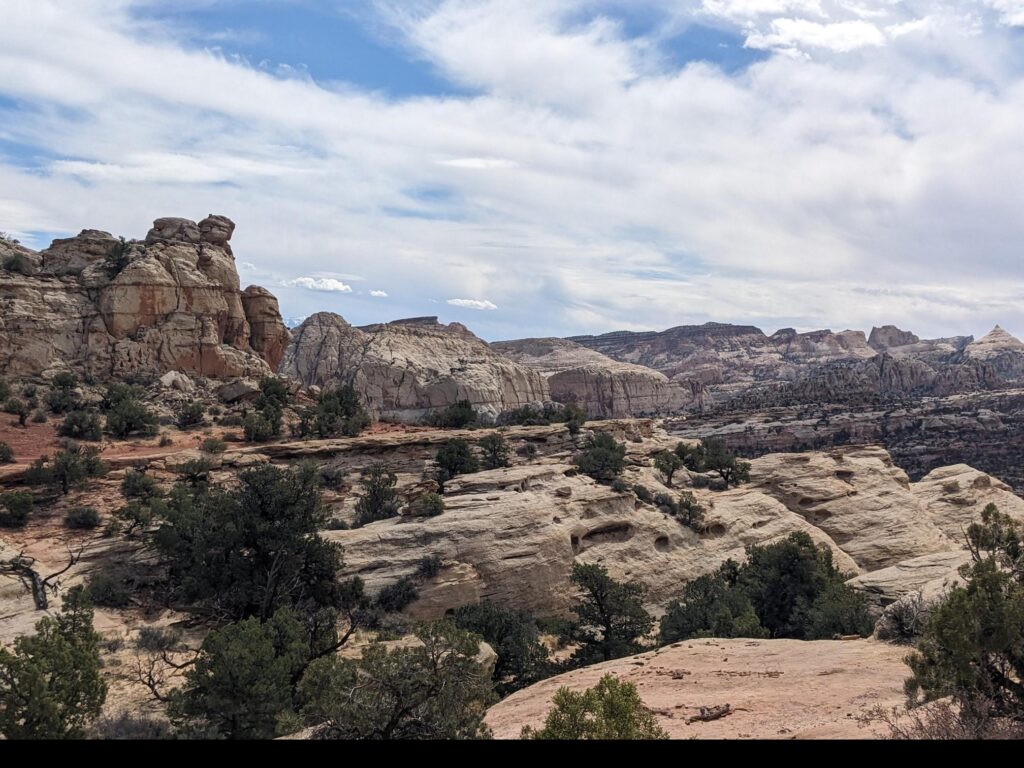
This isn’t too long of a trail (I think about 3ish miles and less than 1000 ft elevation gain). There is an incredible viewpoint of the arch about halfway that if you wanted to stop for the picture, that would be the spot. (the picture above is taken from there)
We continued along to the end of the trail which ends just above the arch looking down through it!! We stopped on top for lunch and then as we headed back down, we ventured out over the top of the arch! It’s so wide across the top, you wouldn’t know you’re walking on an arch, if you didn’t already know it.
We did see someone rappelling down through it and saw a couple of anchor points where people rope in.
Once we got back down to the Wash, we did walk up the Grand Wash for a bit, we were hot and have walked up washes before, so turned back after about a 1/2 mile or so. You can walk the whole wash back up to the main road.
Rim Overlook
Our next day in Capital Reef took us up the Navajo Knobs trail to the Rim Overlook. This day was partially cloudy and we loved the occasional reprieve from the sun when a cloud blew in.
The views from the overlook are spectacular! You can see for miles! The perspective from above shows even more beauty that you see from below. It was well worth the trip up!
We ran into two different couples up there that we chatted with a bit. We always enjoy hearing where other people have been and what they recommend!
Next up, as we headed back down from the Rim Overlook, we veered over to the
Hickman Bridge
This bridge is a short walk from the same trailhead as the Rim Overlook. We got to the side trail and headed to the bridge. This is one that you can easily walk around and underneath allowing for a ton of different angles to view it from.
This must be a very popular trail in the busy times as they have made the end of this trail a loop. (Herding cats….)
We stopped here and ate the rest of our lunch that we hadn’t finished up at the Overlook. It was beautiful (and a bit shady) to stop and enjoy this gorgeous arch.
When we got back to the car, we headed back to Torrey and stopped for ice cream at the Color Ridge Creamery in town. We both decided to get a flight of their ice cream. The lavendar honey was to die for!!!
We loved Capital Reef and plan to include it on future trips to Southern Utah.
Well, some of it! I know I’m using old seeds in order to use up what we have in the house, so I’m attributing that to some things just not doing anything!
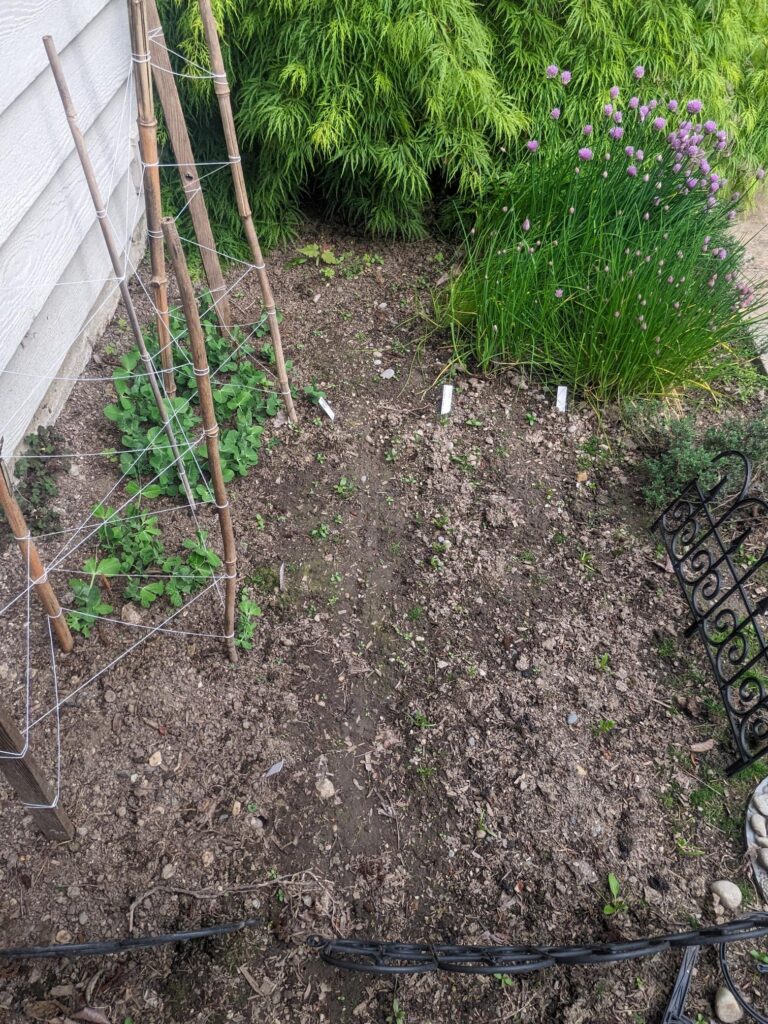
First up are the peas, spinach, thyme and chives next to the house. There were 3 different packets of peas planted, but only 2 came up. Even after a second planting of the 3rd packet, there are still no peas in one section. Oh well, so be it. And the spinach is growing, but seems VERY slow. Maybe that’s just how spinach rolls.
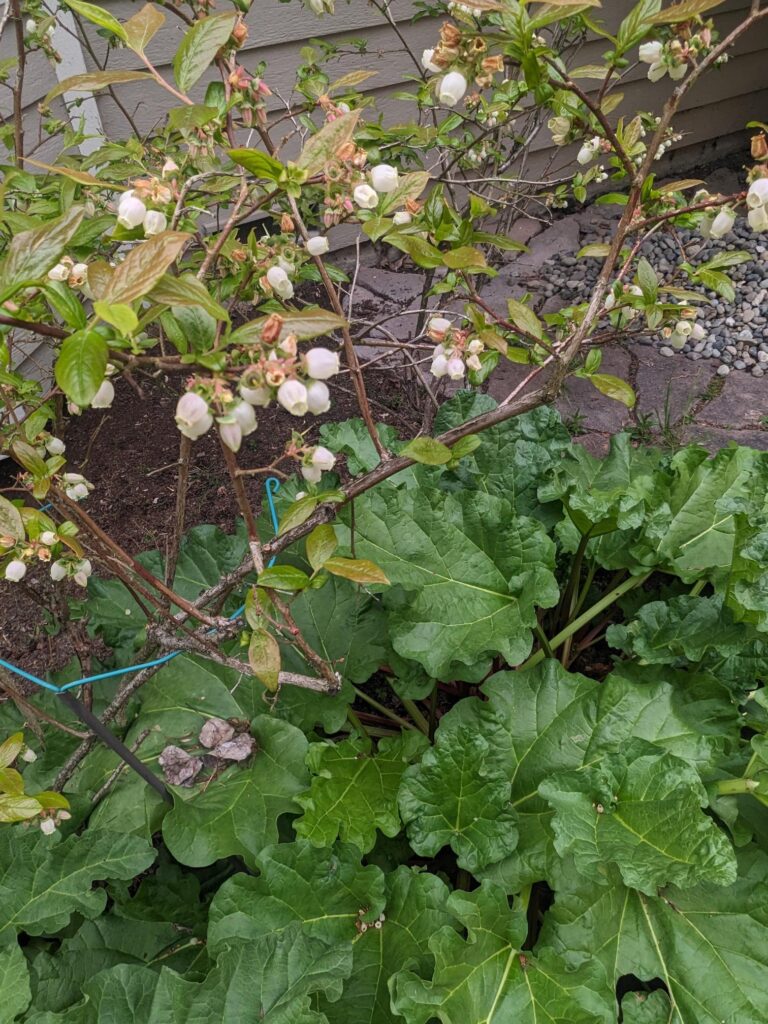
Next up is around the corner to where we have a couple of blueberry bushes and a couple of rhubarb plants. The rhubarb is PROLIFIC!!! Recipes are needed, please share! I did see some raspberry rhubarb jam in a shop last weekend, so I’ll make a batch of that. (I still have strawberry rhubarb jam left from last year). The blueberry bushes are blossoming and I’m seeing bees flying about. Let’s hope they’re easily finding their way into those wonderful, pollen-filled blossoms!
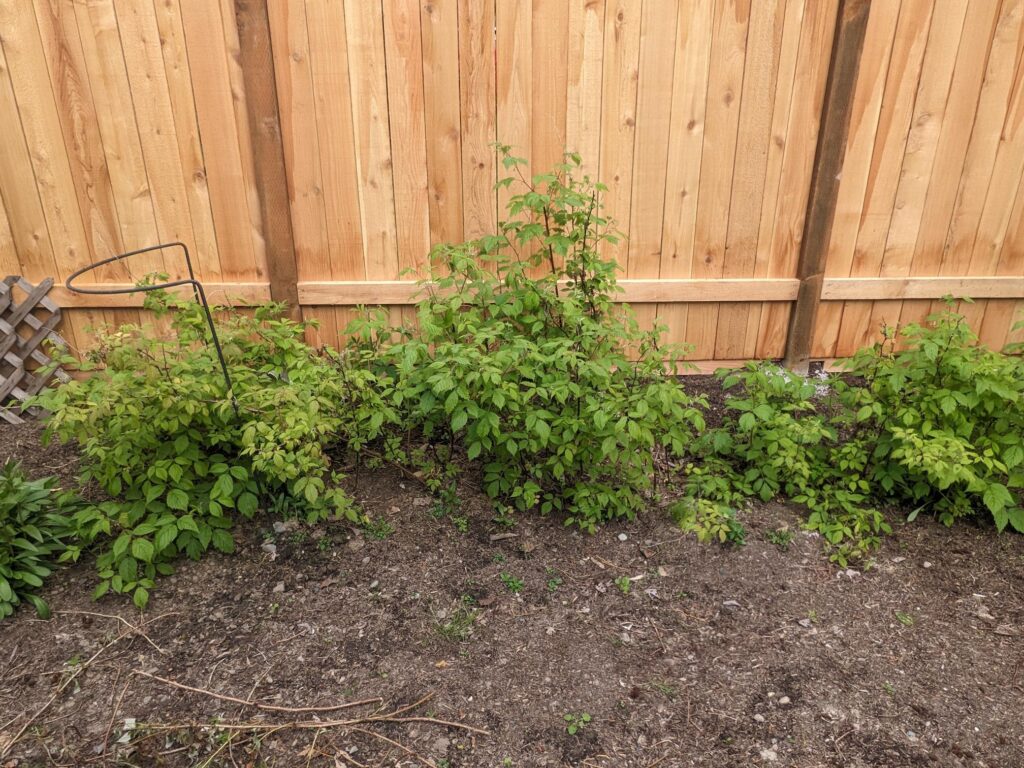
Across from there is the raspberry patch. I trimmed back quite a bit this spring once I could see what was no longer growing. I discovered last year that our raspberries are everbearing. That means that we get 2 harvests (spring and autumn) and the canes will fruit year 1 and year 2 and then are done.
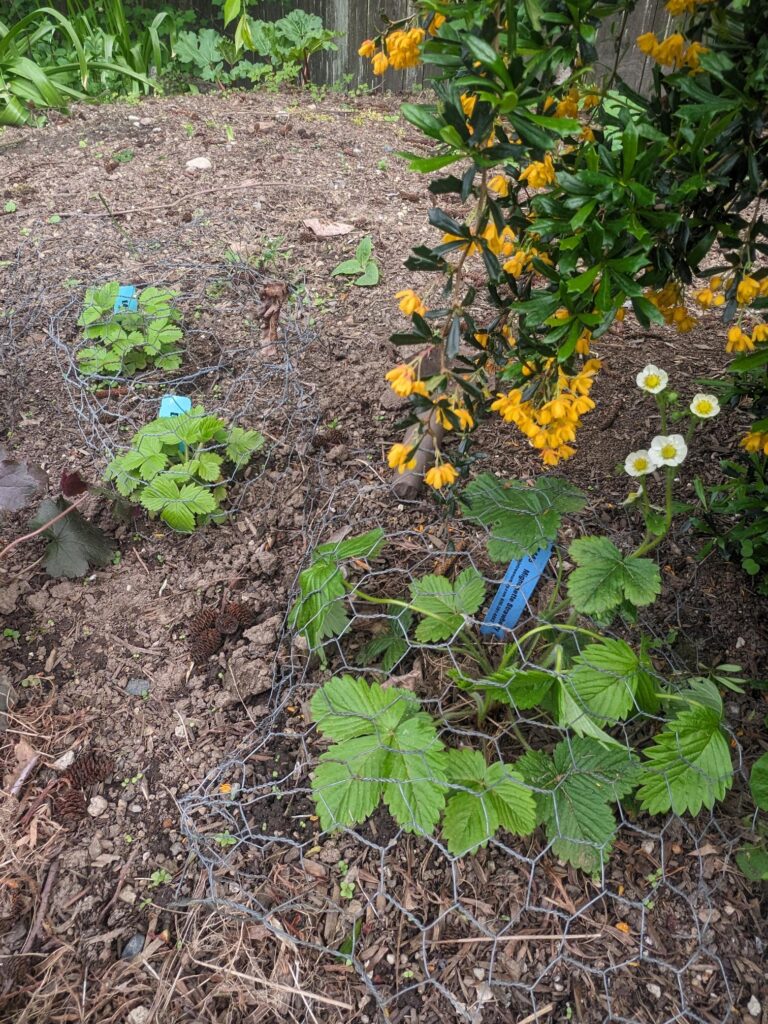
Around the fence line to the ‘mound’ are the strawberries. This area is partially shaded, so I have chosen to have a feature strawberry here rather than something that will produce a huge crop. I have planted alpine strawberries last year and this year. They are coming along well and I assume they will continue to expand in the area I have them planted.
(They are covered in chicken wire because we have bunnies “Henry” in the backyard and they are able to hop around in this area)
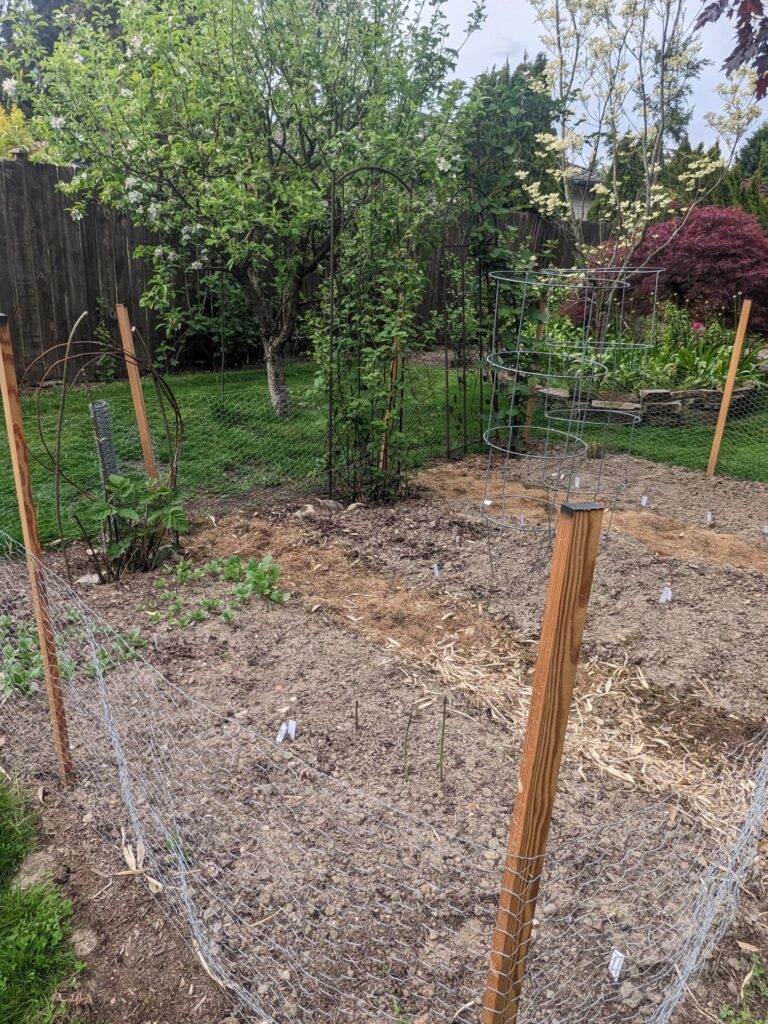
Now to the main garden! I planted spinach, beets and radishes in the first third awhile ago. The radishes are coming along well and I thinned a few the other day. The beets seemed to start, but have stopped growing. I keep planting more in hopes that some will do something! And the spinach is coming along (about the same as the spinach in the other part of the yard).
We also have asparagus in that section of the garden but thought I had killed them last year. Thankfully, we have a few spears that came up. I will not pick these and leave them to go to seed. Allowing asparagus to go to seed will feed the roots below the ground which will make for better crops in future years. (I knew that and had a momentary brain glitch last year and picked them all which is why I thought I had killed them)
Two of the three apple trees are blossoming. The one not flowered was pruned a LOT this winter. We’ll wait to see what happens with that one. It may need a year to recover.
In the middle section of the garden, I planted potatoes, kale and carrots. NOTHING is coming up….yet. After letting that area go for a few weeks with nothing popping up, I have now added broccoli and cauliflower seeds to the edge of where I put the potatoes. I planted peas where the kale was (hence the tomato cages for them to climb). I planted more carrot seeds and some onion seeds along the front edge of where I had put the carrot seeds. We’ll see what happens.
When it’s time to put the pepper starts in the ground, I will put them in the carrot area. One will grow up, the other will grow down. They can share the space! 🙂
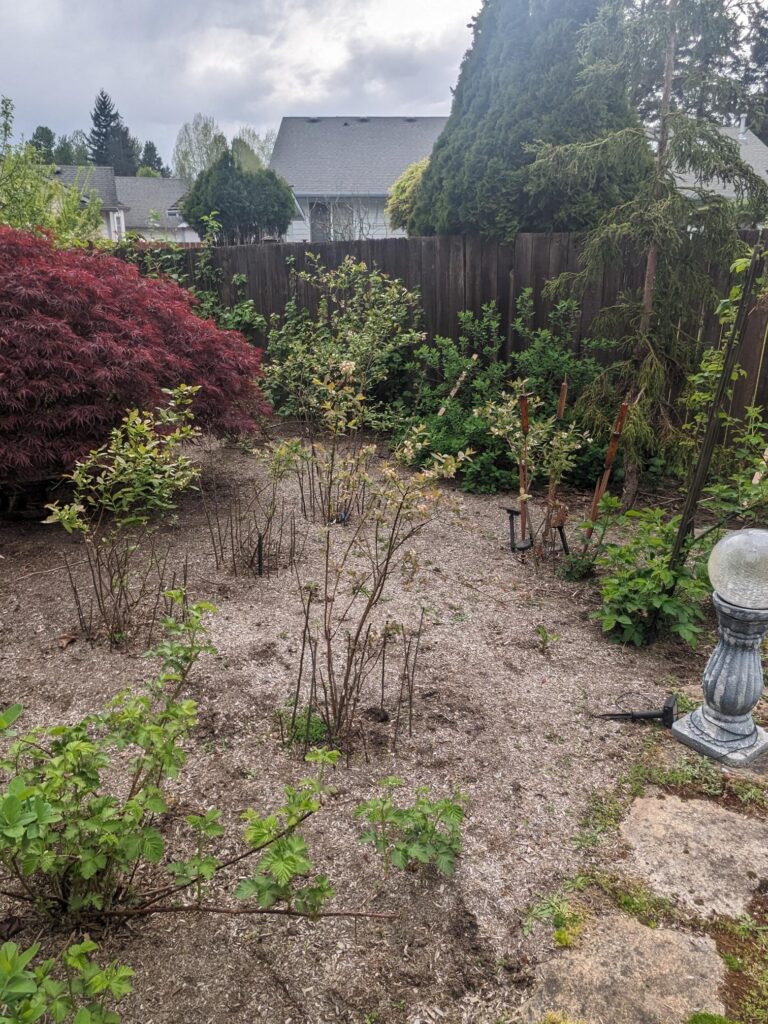
Next up around the circle of the yard is the berry patch. We have more blueberries, raspberries, boysenberries, honey berries (haskaps) and red and black currents.
The blueberries, honey berries and currants are all blossoming. The other berries should start blooming soon.
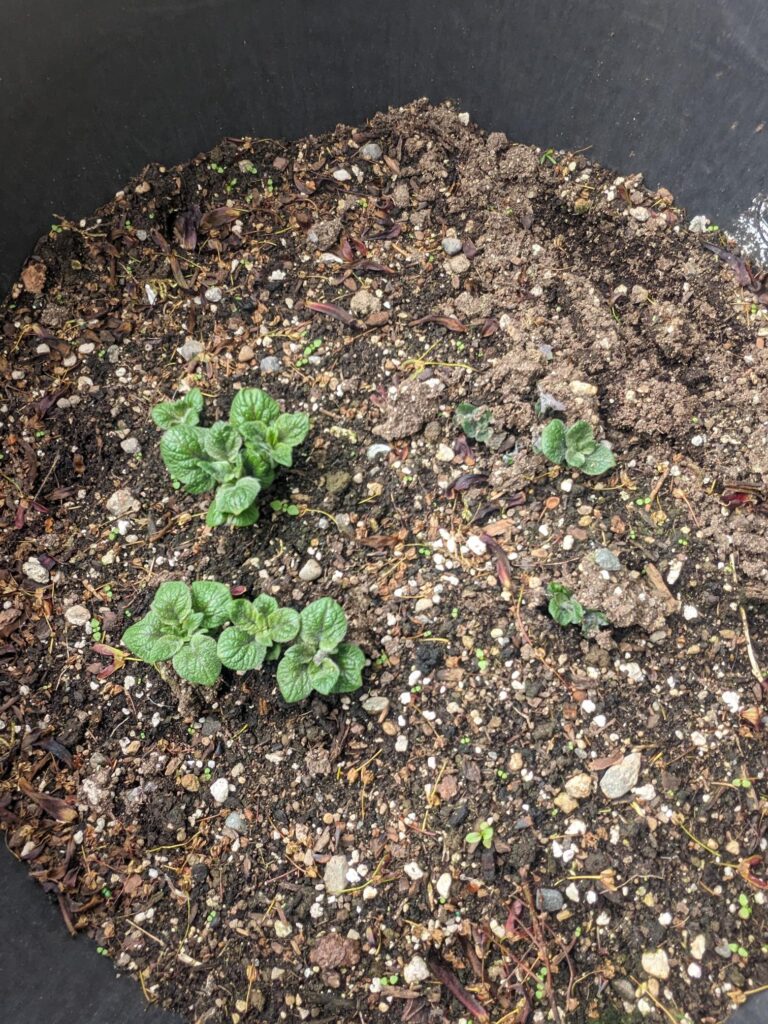
I also planted potatoes in a pot as well as a spot in the garden. Those are coming along well and have started growing above the ground. I’ll let these leaves get about 4-5 inches tall and then I’ll put more soil in the pot to get more to keep growing.
I’m excited for the potatoes to blossom. Have you ever smelled a potato blossom???
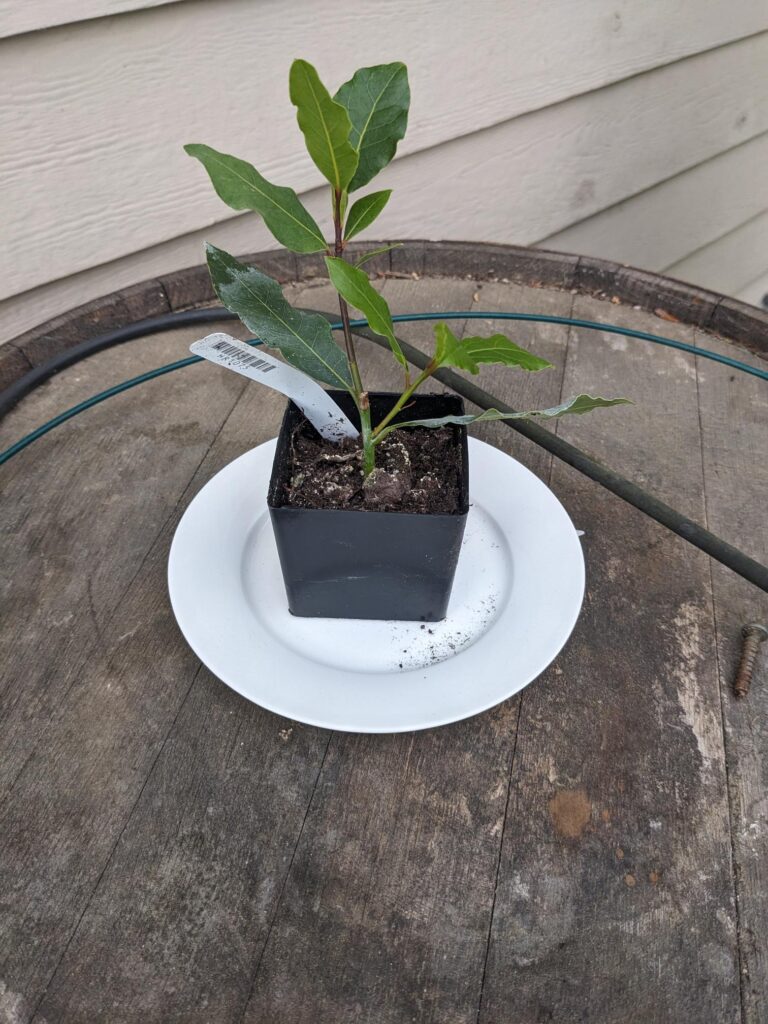
And finally, I have a little bay laurel waiting to get planted. I’m excited to be able to have bay leaves on hand for future soups!
Other garden activities have included transplanting pepper, tomato and cabbage starts into bigger pots. They’re pretty puny looking, but hoping that they get bigger and stronger with more room. By the end of the month, I’ll start moving them outside to start the hardening off process.