Category: Learning New Skills

Skills that can help increase your frugality and save you money along the way.

  • Rendering Tallow

    Beef tallow – I see it everywhere these days. It’s getting the bad rap removed and the benefits are coming back to the forefront. Our ancestors used this for so many purposes, and I decided to give it a try.

    Hubby & I recently bought some sirloin and ground beef at CostCo. As the hubby was cutting the sirloin into steaks, he was cutting off quite a bit of fat and throwing it away. I stopped him and told him to save the rest and put it in a bowl. I would render the tallow.

    I then was going to cook up the 5.5 lbs of ground beef and freeze it and decided to use the fat from that as well. (Of course, I poured off the fat before I did any seasoning of the meat)
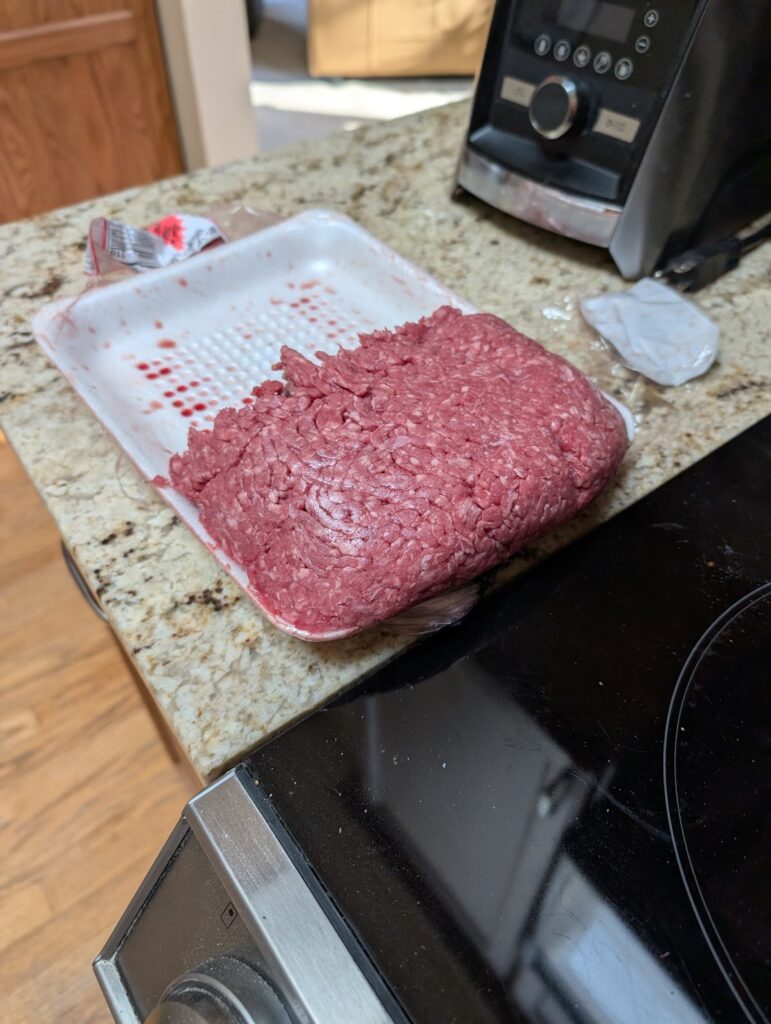
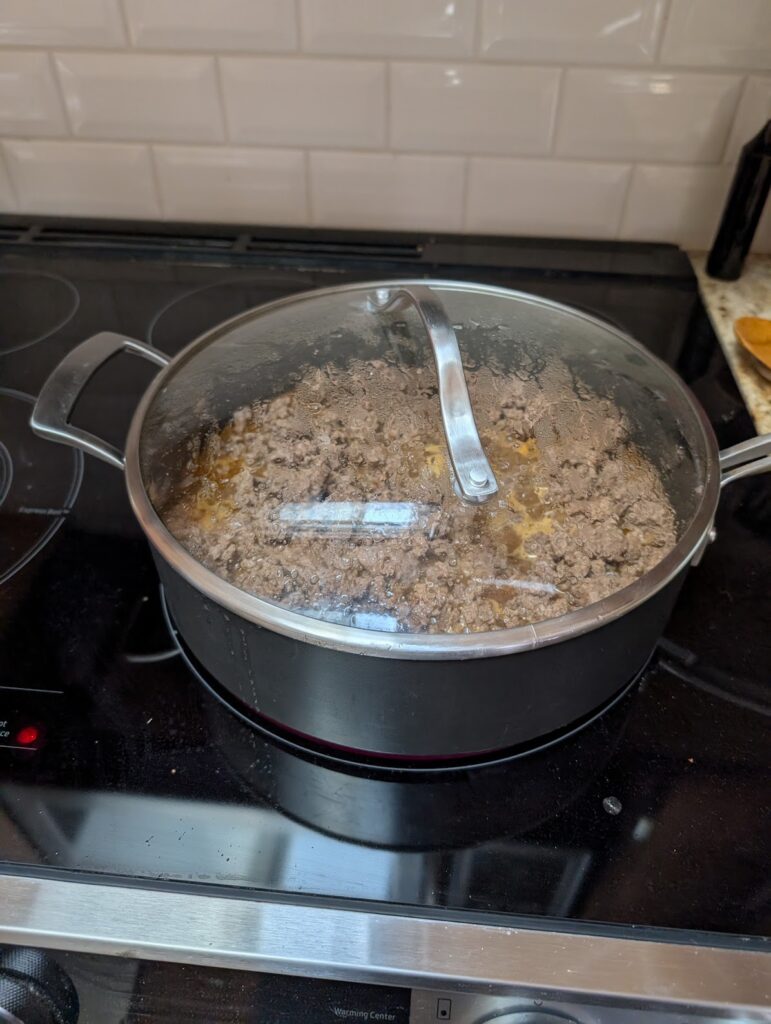
    (Aside – I cooked up about 3 lbs as taco meat and portioned out into vacuum sealed bags to freeze. And cooked up the remaining and kept it plain to be able to throw into other things that call for ground beef)

    I put it all into a crockpot and let it go on low all day. It didn’t liquify quite as I expected it to, but there was still a lot in there.
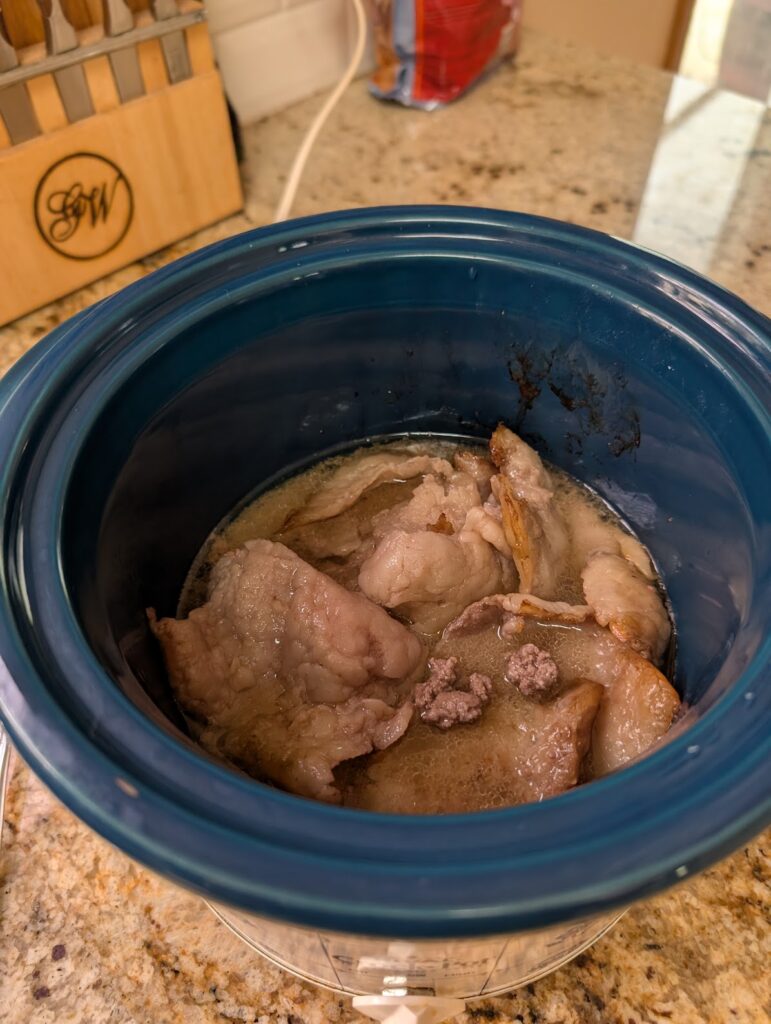
    At the end of the first day, I strained it into a bowl and refrigerated overnight.

    The next day, I took the bowl out of the fridge and turned it over onto a cutting board to be able to scrap off the stuff that would have gone to the bottom of the bowl.

    Well, that didn’t go quite as planned. I wasn’t expecting so much gelatin in the bowl, so the fat layer came off the top and gelatin went all over the counter.

    Once I got that cleaned up, I scrapped off the non-fat bits from the bottom of the fat layer and put it back into the crockpot to go for another rendering.
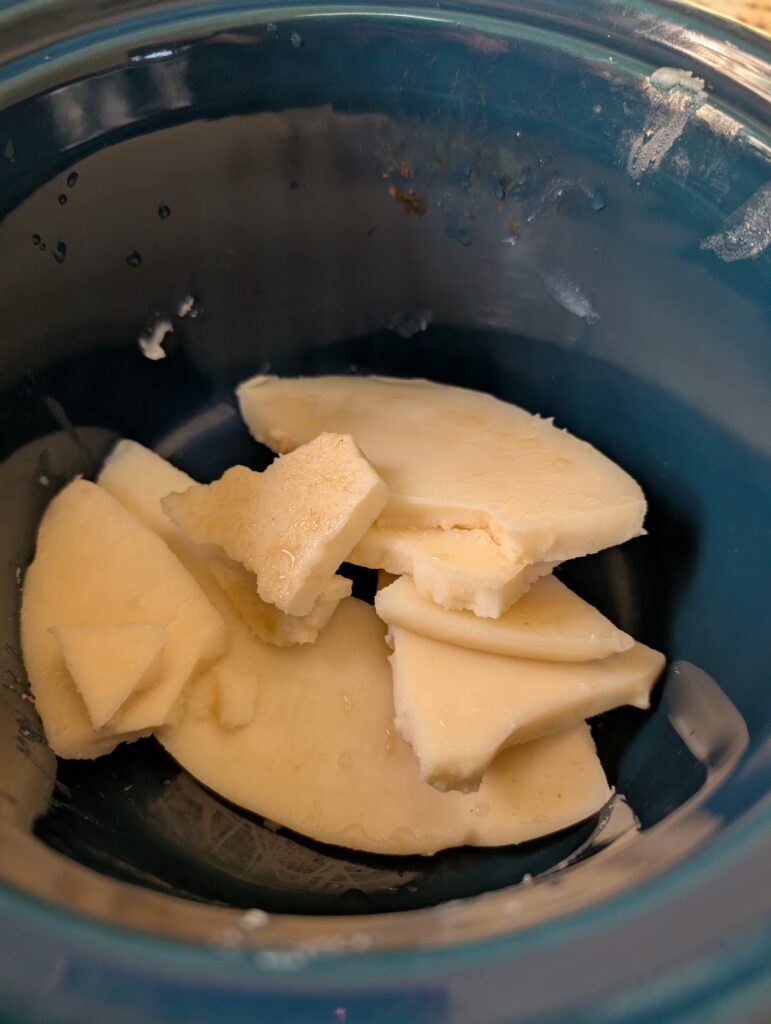
    When I took it out of the fridge, there were small yellow circles randomly across the top of the fat. (You can see some in the picture above) And I knew there would be beef bits hanging out below where I could see in the bowl.

    I’m expecting it will take 3 renderings to get it to the pure white I’m expecting. (But, given that this is likely not grass-fed, grass-finished really cleanly raised beef, there’s a good chance it won’t come out as pure white as I hope it does. Time will tell.)

    (I’m writing this post as I go, so at this point, I don’t know the ending!)

    Day 3 rendering has been done. The tallow still had a beef smell to it but looked right. I did a bit of digging on Pinterest and it turns out to “purify” it, I needed to melt it down with some salt & water.

    After doing that, I poured through a fine strainer into the bowl again and could see a bit of impurities at the bottom as well as water droplets.
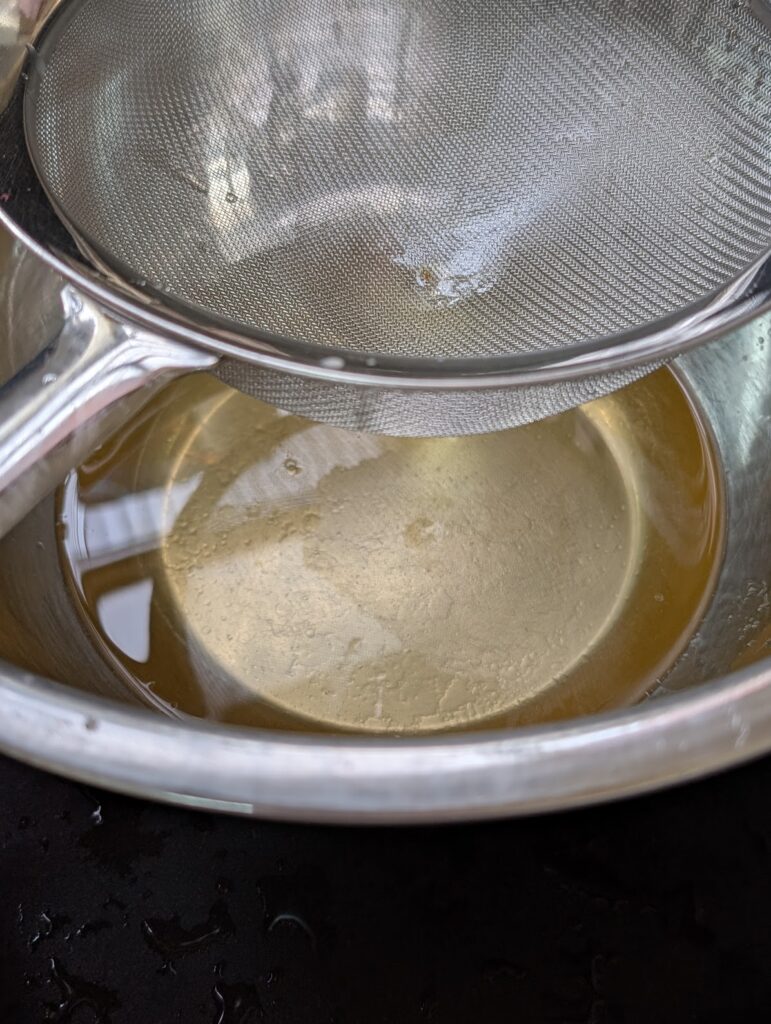
    Once it cooled in the fridge and I pulled out the fat, the water and impurities stayed at the bottom of the bowl, and I was able to melt once more to pour into the mold I wanted for keeping it until I use it.

    Since I purified it, I will be able to use this for cooking or making soap or other beauty products. I’ve been wanting to make soap and will likely use at least some of this tallow for that.

    It’ll be fun to use it. There’s something satisfying about making things from other things and not having as much waste or having to go to the store.
  • Reusable Paper Towels

    *Updated 1/9/2025 – scroll to the end for the update

    In previous posts, I’ve mentioned that I am looking for ways to avoid the stores (thus saving money). I was at a garden show earlier in 2024 and one of the vendors was selling reusable paper towels. The vendor’s stuff was cute, but she didn’t have the color scheme I was looking for.

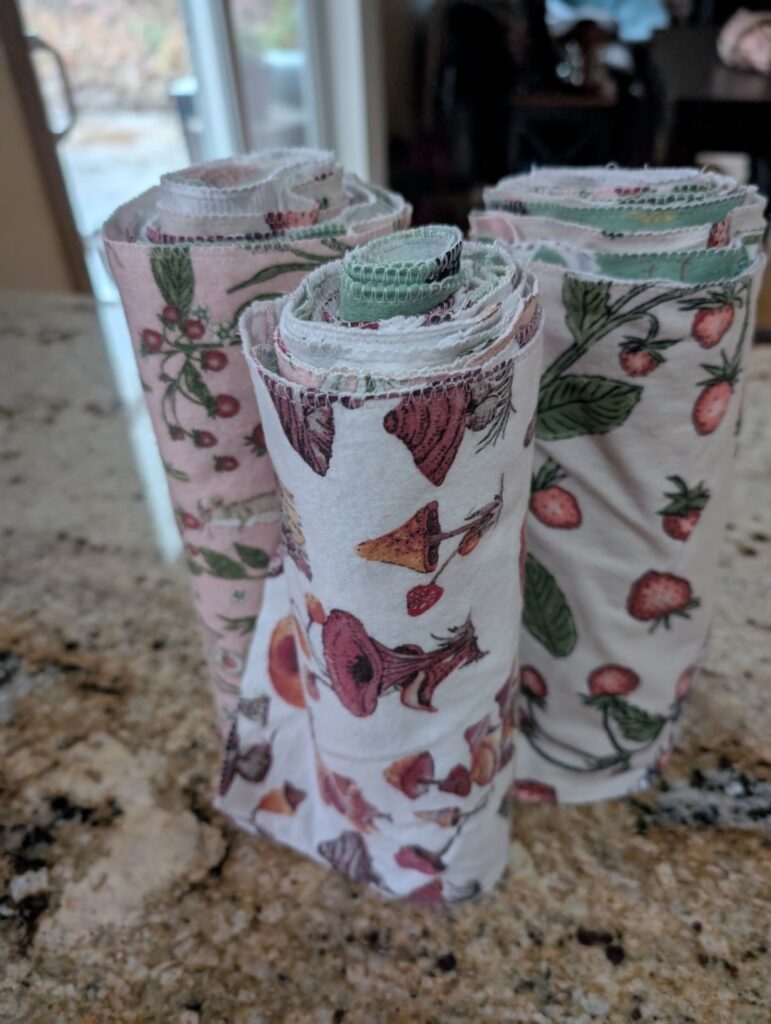
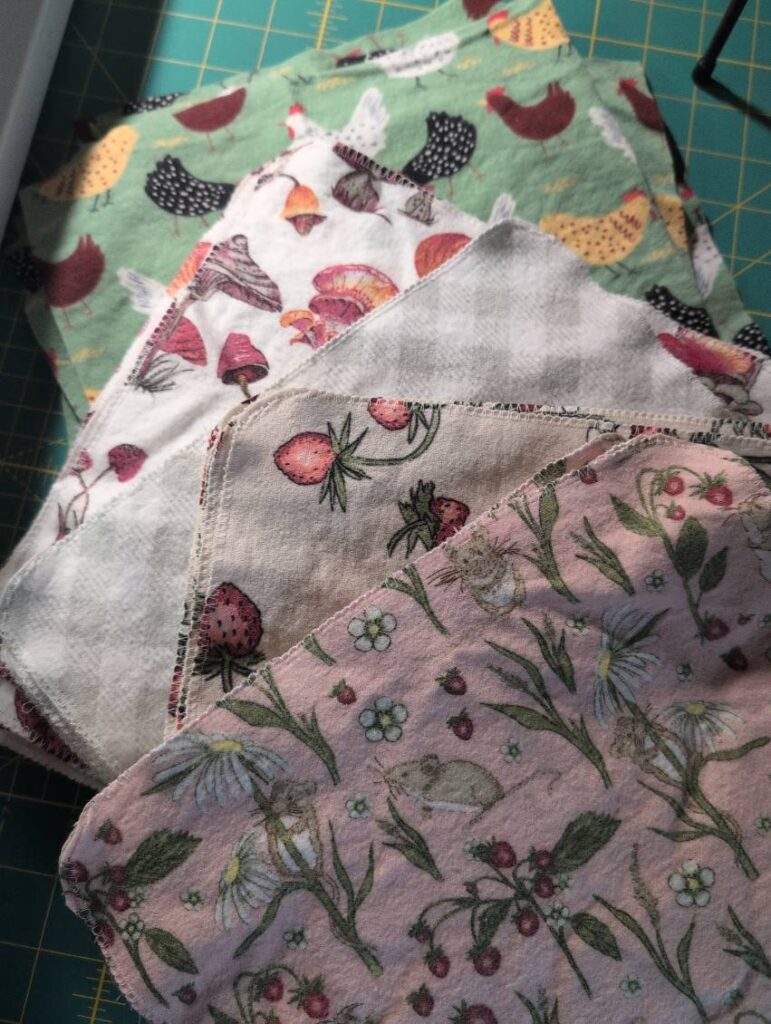
    I looked over the product she was selling and thought “this is easy enough that I can make it myself.” It was flannel cut into 10×10 squares and the edges were ‘hemmed’.

    I went to the fabric store and purchased a yard each of flannel that was more to the colors/patterns that suited me.

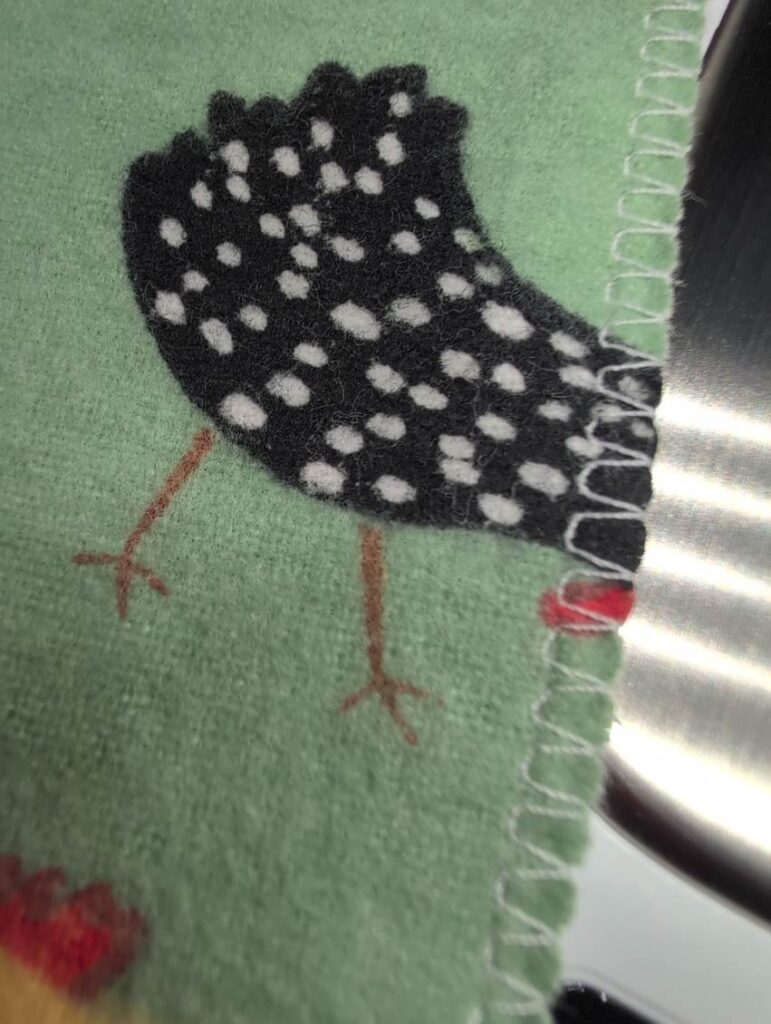
    I received a new sewing machine for Christmas and was thrilled that it has the stitching ability to do the ‘hemming’ that I wanted to do. (It’s an overlock stitch)

    Like all projects, I procrastinated in getting started, but mostly that was due to waiting for the new sewing machine.

    I started by washing the material, so any shrinking was done before cutting and stitching. I then cut the material into 10″ by 10″ squares. (The material was folded so I was cutting more than 1 square at once)

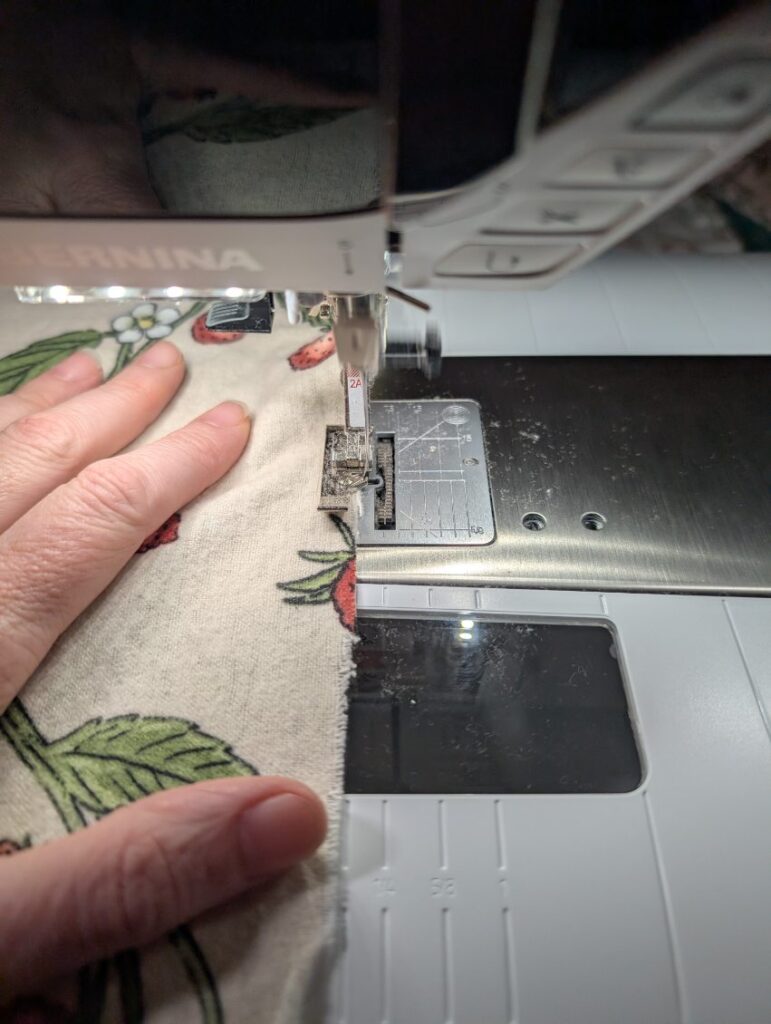
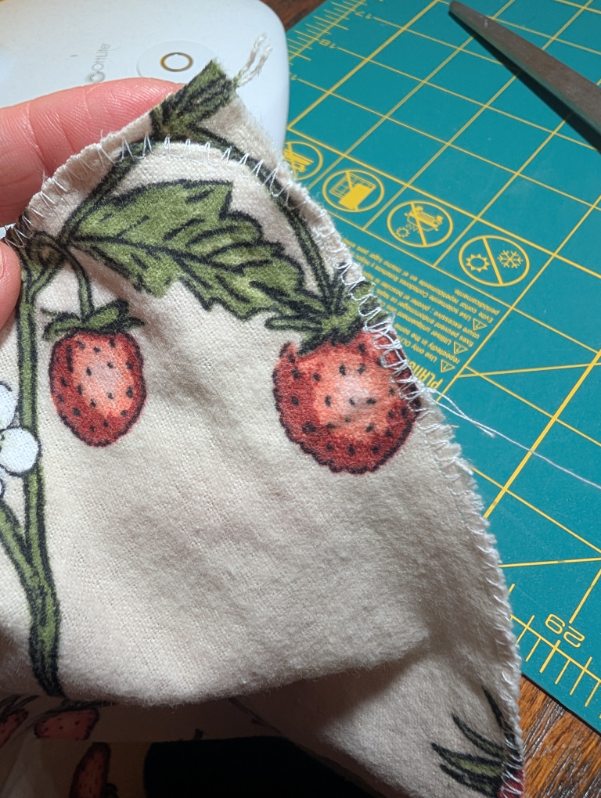
    I then starting using the overlock stitch on my machine to finish them up. Sewing squares isn’t all that exciting. LOL

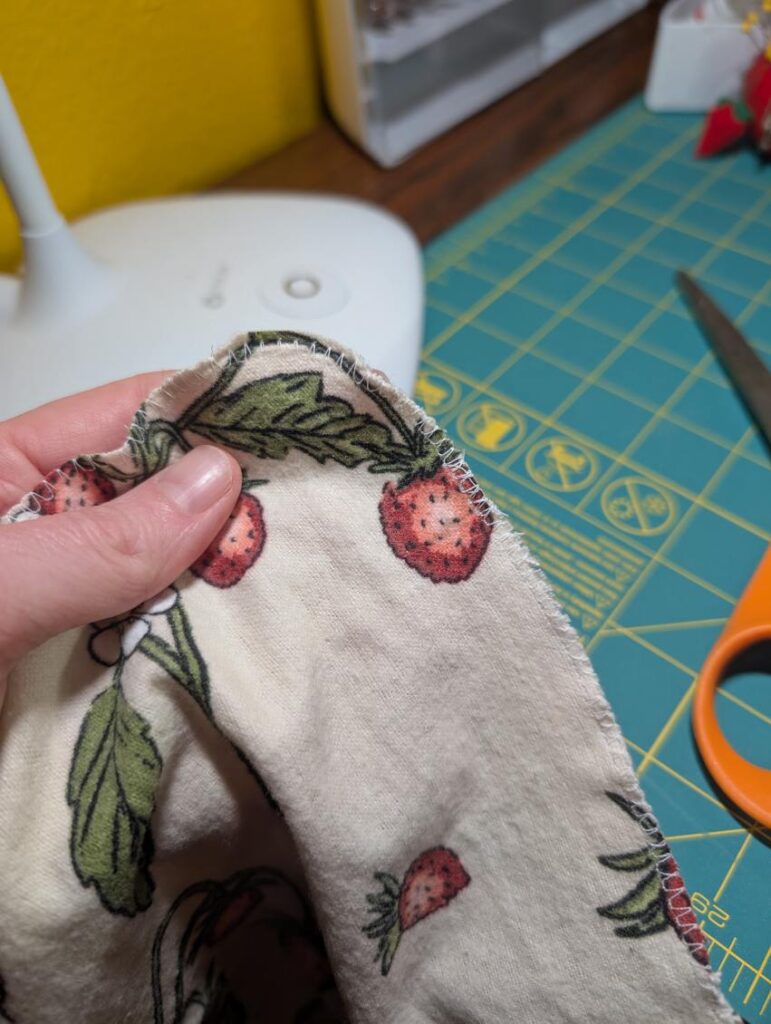
    Once I got all four sides done, I snipped any threads, and cut off the rounded corners with a good paid or scissors.

    I was careful around the corners to not cut the overlock stitch. I do expect a bit of fraying on those corners when I wash it. But, it’ll do that until the material falls off to the stitch and then it should stop.

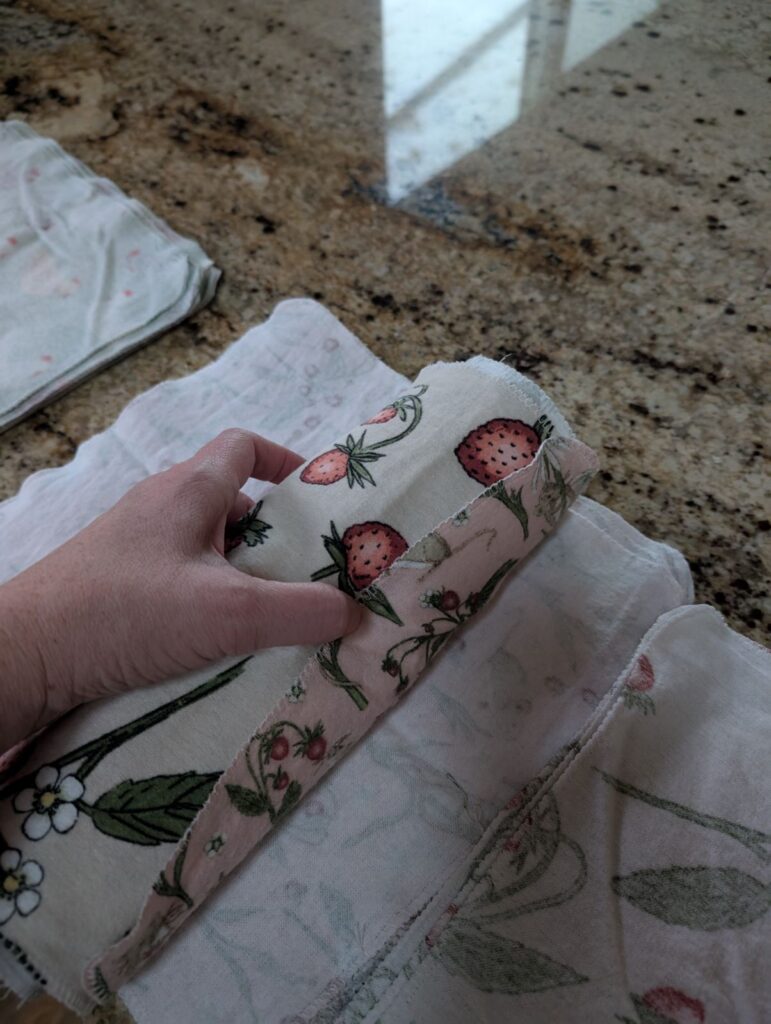
    To roll them up like paper towels, I rolled one, then overlapped it with the next and kept rolling. It turns out 5 yards of material end up making about 3 rolls of ‘paper towels’. (I have scrap material left, but none that was large enough for paper towel size.)

    But they are finished and I love how they turned out!

    One less thing to have to buy at the store!

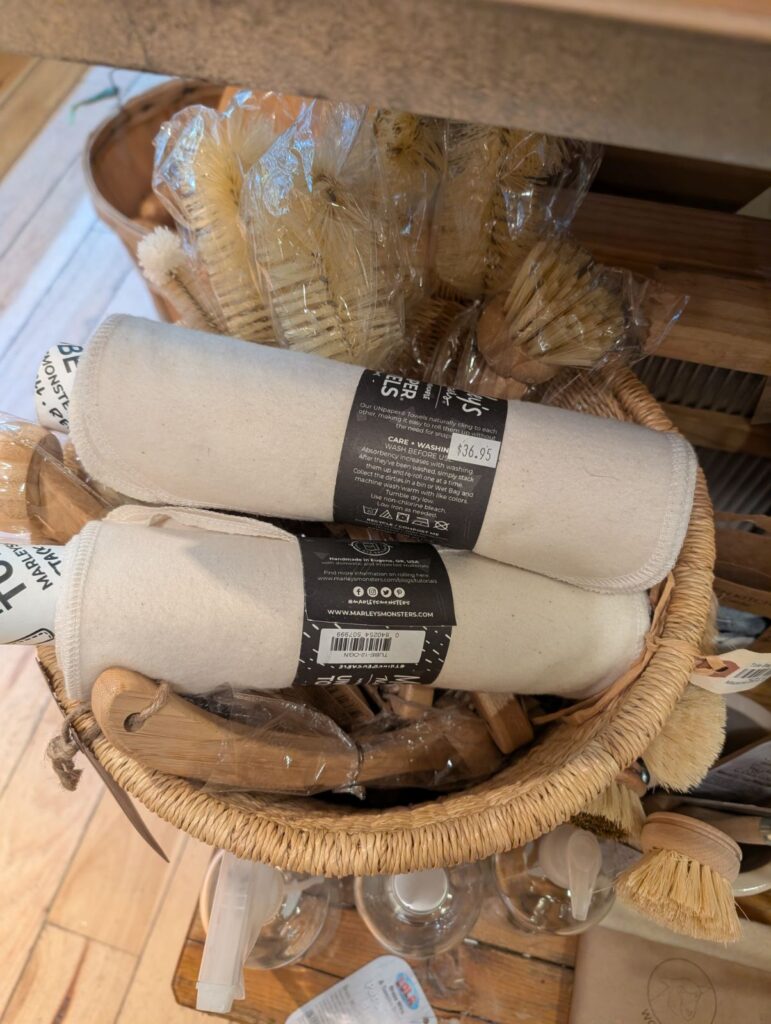
    Update: 1/9/2025 – My husband and I took a vacation on the other side of the mountains and the town has an adorable little store that we love to stop in at. Low and behold, they had some reuseable paper towels – 12 for $36.95!!!! :O This was definitely a cost savings.

    These are just like I made, but plain. I spent about $25 for 5 yards of material and used a spool of thread I already had at home. I ended up with about 55 ‘paper towels’. Holy cost savings Batman!!!!

  • A Day in the Life – Probiotics

    *a few of the links in this post are affiliate links. That means if you click and order something, I’ll make a few pennies.

    What does a day in my life look like? Most days are pretty similar. Some days I have more energy than others or get more ambitious than on other days.

    Rather than lay out a whole day of what I’ve done on a particular day, I’ll instead give a glimpse into random activities I do.

    In my ‘homestead wife ness’, I’m still making kombucha and kefir regularly. I have made fermented vegetables. I’ve pickled red onion and radish seed pods. And I’ve made sourdough.

    Kefir is a daily or every other day task, but is quite simple.

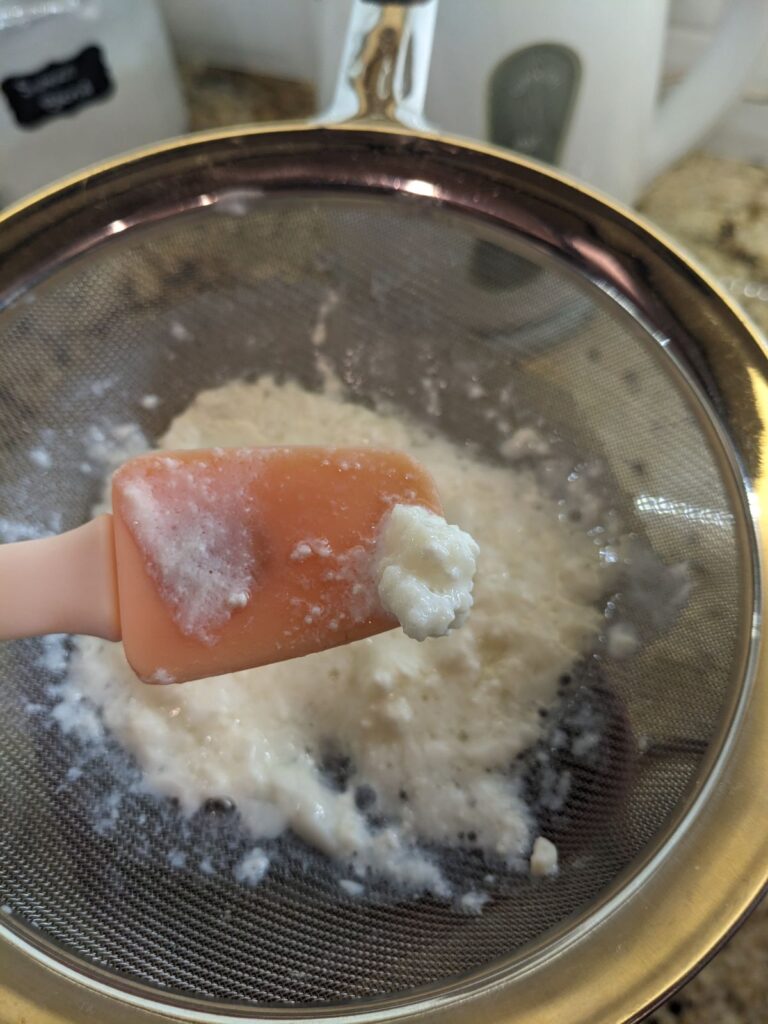
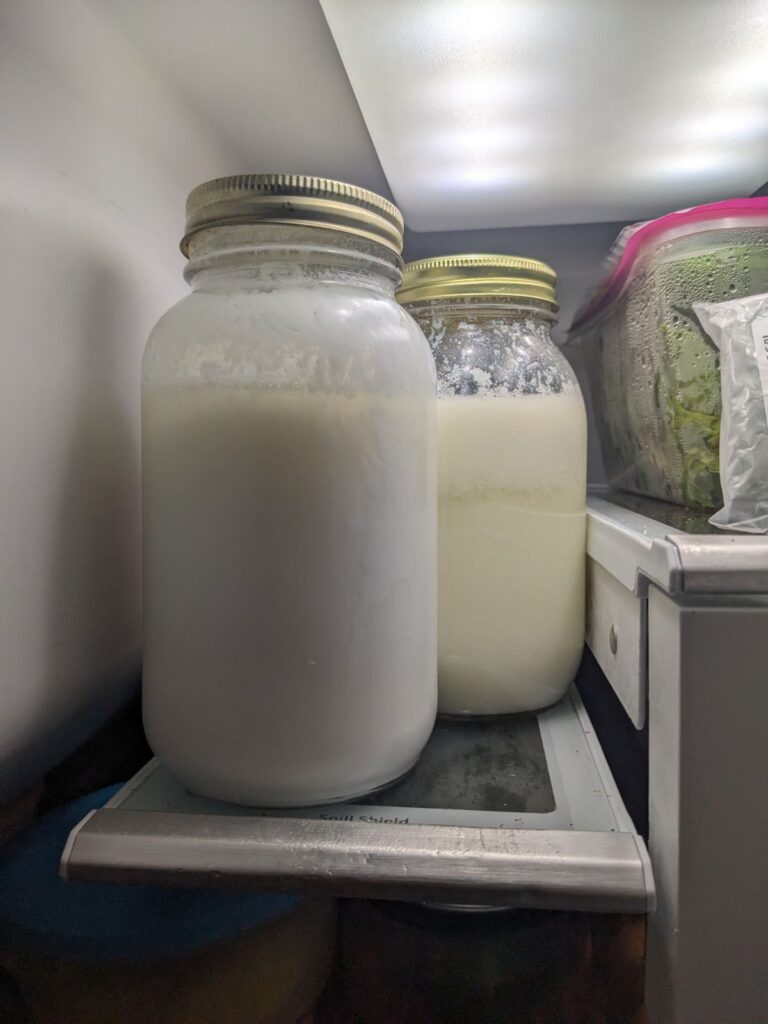
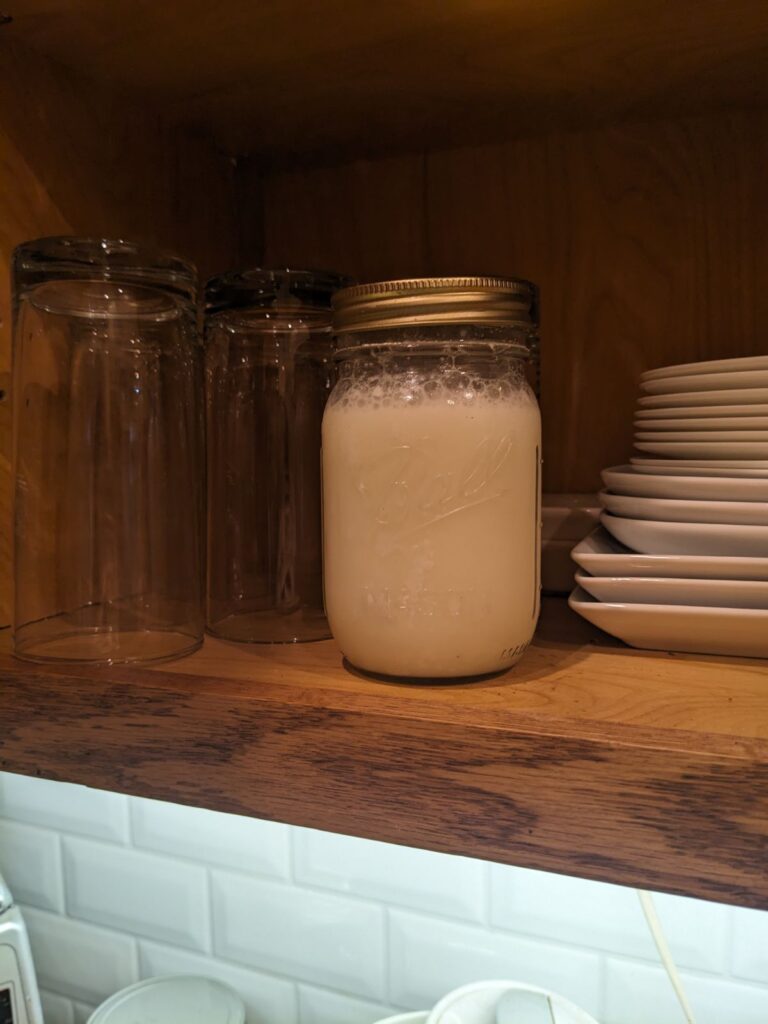
    What is kefir you ask? It’s fermented milk. Before you wonder what has gotten into me and why I would drink bad milk, let me tell you! It’s NOT bad milk, its fermented. I have ‘grains’ that I put into milk, let it sit (unrefrigerated) for about 24 hours (sometimes longer if I forget about it) and then I strain the kefir into a new jar and put the ‘grains’ back into the original jar and add more milk to start the process over again. (‘Grains’ look like tapioca beads)

    Kefir “Grains”

    The grains will ‘eat’ the lactose in the milk leaving behind really good-for-you bacteria that is amazing for your gut! I’ve read that people who can’t do dairy CAN do Kefir because once the bacteria have done their thing, the part that constitutes a ‘dairy product’ has been eaten and it no longer there to cause issues.

    It tastes like drinkable yogurt. I like drinking it cold which is why I refrigerate the strained kefir. I add a splash of vanilla and a 1/36th tsp (doonk) of pure stevia powder – drinkable vanilla yogurt.

    Looking for a really good, cheap probiotic? KEFIR – find some grains and use store bought (NOT ultra-pasteurized) milk.

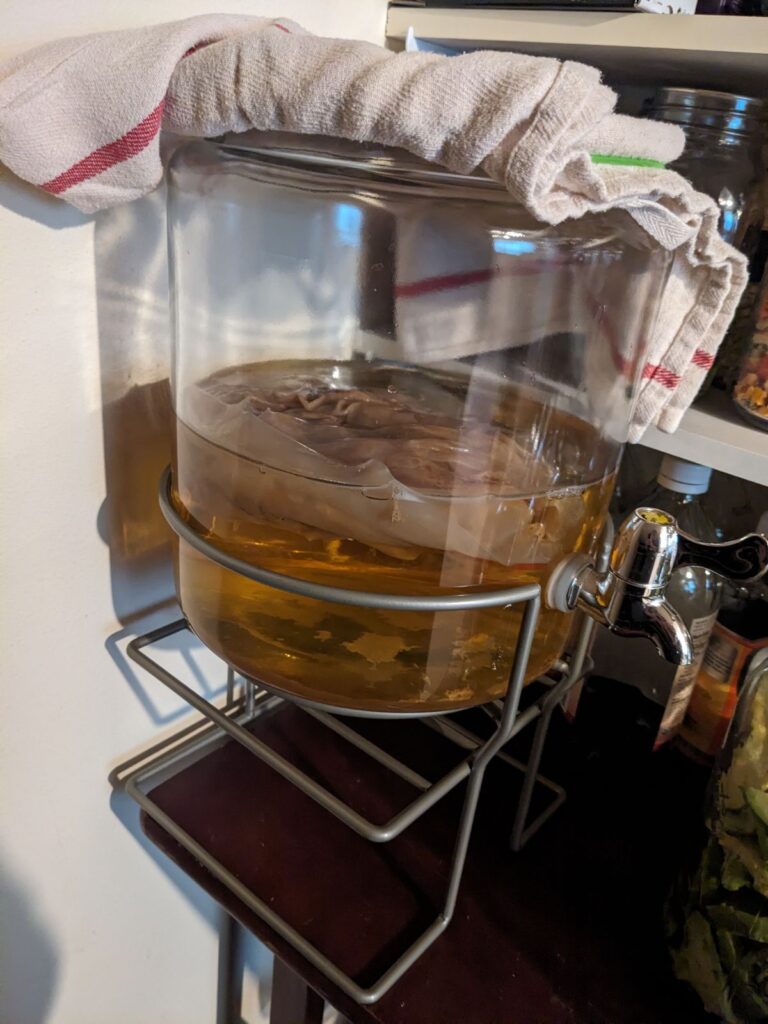
    Kombucha is also an ongoing adventure. What is kombucha, you ask? It’s fermented tea! (sensing a theme, maybe?) You can start from scratch, but I’ve always either bought or gotten a SCOBY (Symbiotic Culture of Bacteria & Yeast) to get things started. I brew 2 cups of tea with 1 cup of sugar (basically make a sweet tea), then after it cools to room temp, I add that to the SCOBY and about a cup of tea from the last batch and then add enough water to have a gallon of tea.

    Kombucha brewing in the closet (the big slimy thing floating is the SCOBY – it’s eating the sugar)

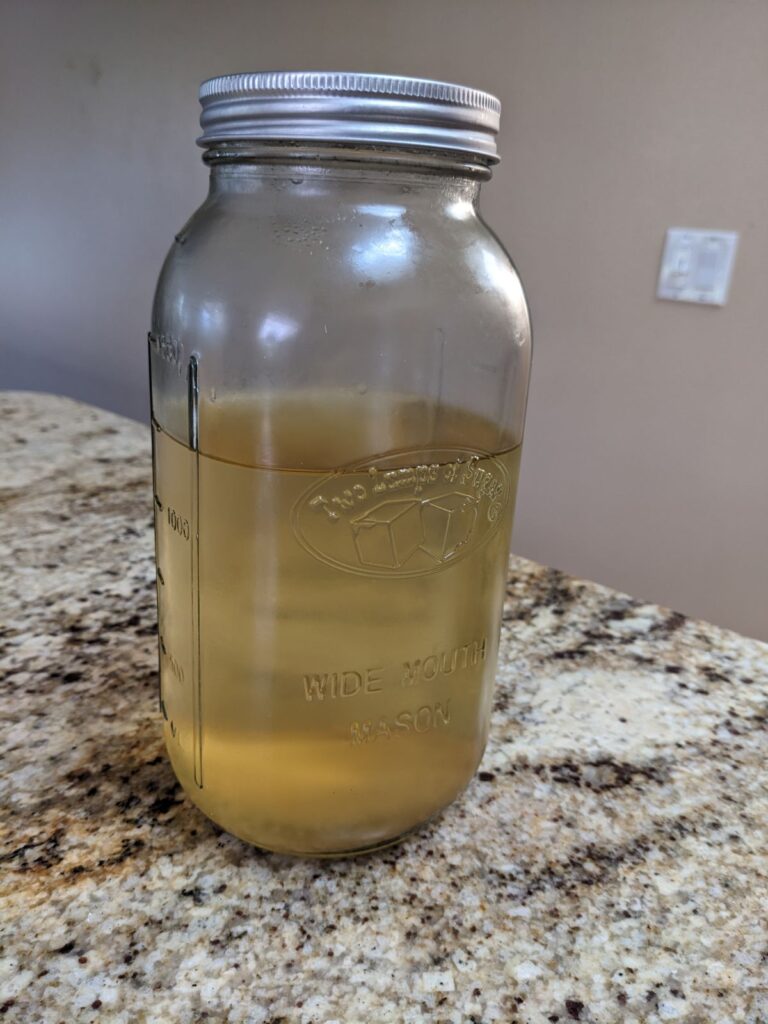
    That tea then sits in a dark closet for at least 2 weeks (usually longer) while the SCOBY eats the sugar. After about 2 weeks, I taste it to see if its ready. I don’t have an exact science for it, but I can tell by taste when it gets to where I want it. When it’s ready to bottle, it has a slight effervescence (light a light champagne) with just a hint of sweetness. If it has a vinegar taste, I’ve let it go too long, but I actually still like it a bit tart, so it doesn’t go to waste. I have yet to try much with second fermenting to get flavors added, but that is the next step.

    Liquid gold – Kombucha ready to drink!!

    Again, looking for a cheap, healthy probiotic – KOMBUCHA! It’s the cost of 2 Tbsp of loose tea and a cup of sugar.

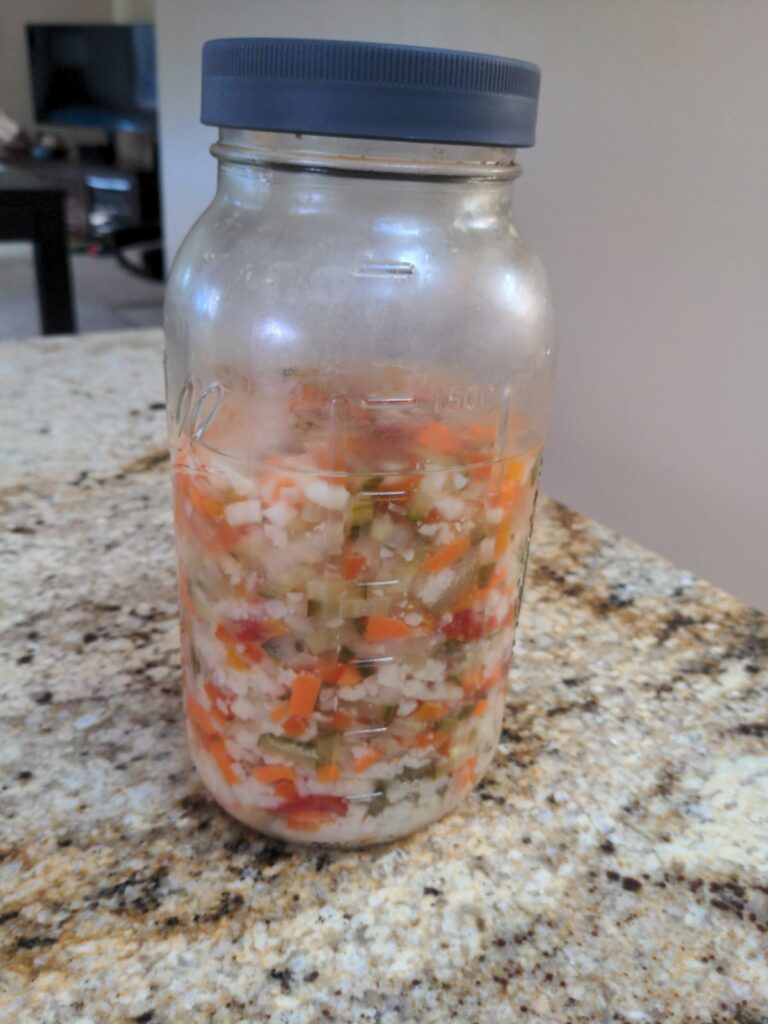
    For the fermented vegetables, I used a recipe I received for signing up for a THM coach website (A Joyful Life with KJ). I’ll admit these took several times of eating to actually enjoy them. But I really DO like them! They’re a big mix of vegetables that I put in half gallon mason jars and use fermenting lids* with weights to ferment for a couple of weeks before they were ready.

    Fermented vegetables (1 jar was 1/2 the batch)

    Again, really good for you, yummy healthy probiotic – FERMENTED VEGETABLES!!!

    Did you sense a theme here? The more I learn about health and my own personal health, the more I hear about the importance of a healthy gut. Good, fermented foods are essential to help introduce good bacteria to your body. The standard American diet with ultra-processed foods has us lacking good bacteria and teeming with bad bacteria which causes all kinds of havoc. If you have some gut issues (or even some you wouldn’t associate with your gut), give some good, fermented food a try and see what that does for your health!

    If you want to learn more, take a look at Donna Schwenk’s books:
    Cultured Food for Life*
    Cultured Food in a Jar* (or via Kindle*)

  • Radish Seed Pod Pickles

    umm…what in the world??? Radish Seed Pod Pickles?

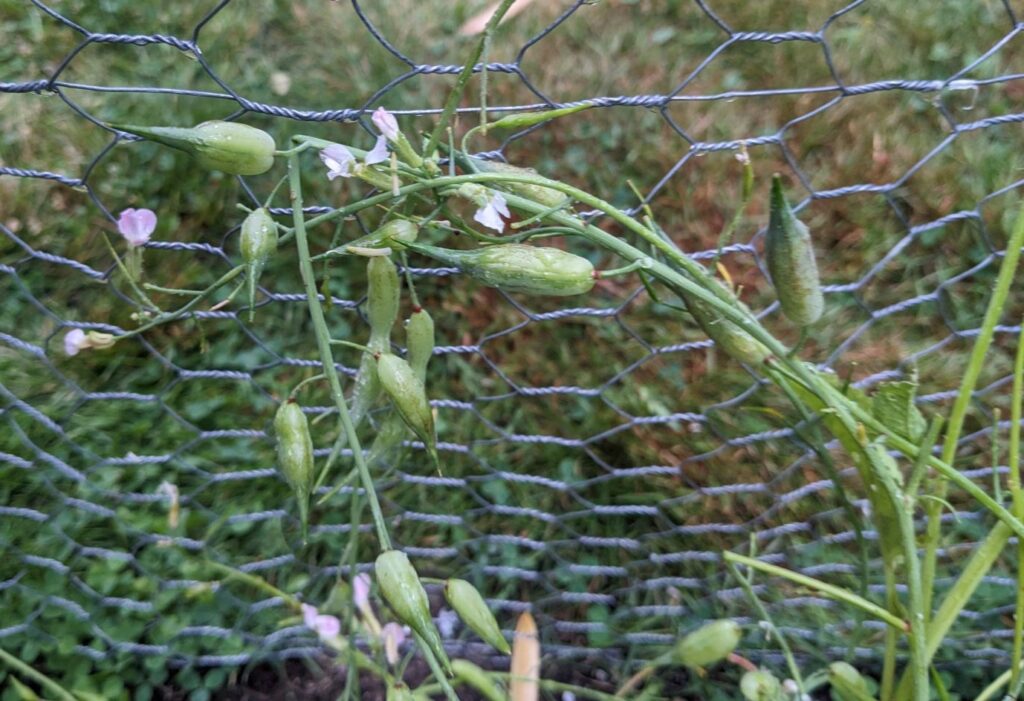
    Radish Seed Pods

    In looking at Pinterest or some other gardening something in the cyber world, I came across the fact that radishes go to seed in pods. And those pods are edible.

    In the spring, I was frustrated with my garden not producing well and knew it was likely due to old seeds, so in an attempt to not be wasteful, I threw those old seed packets onto the garden in hopes that they MIGHT grow into something!

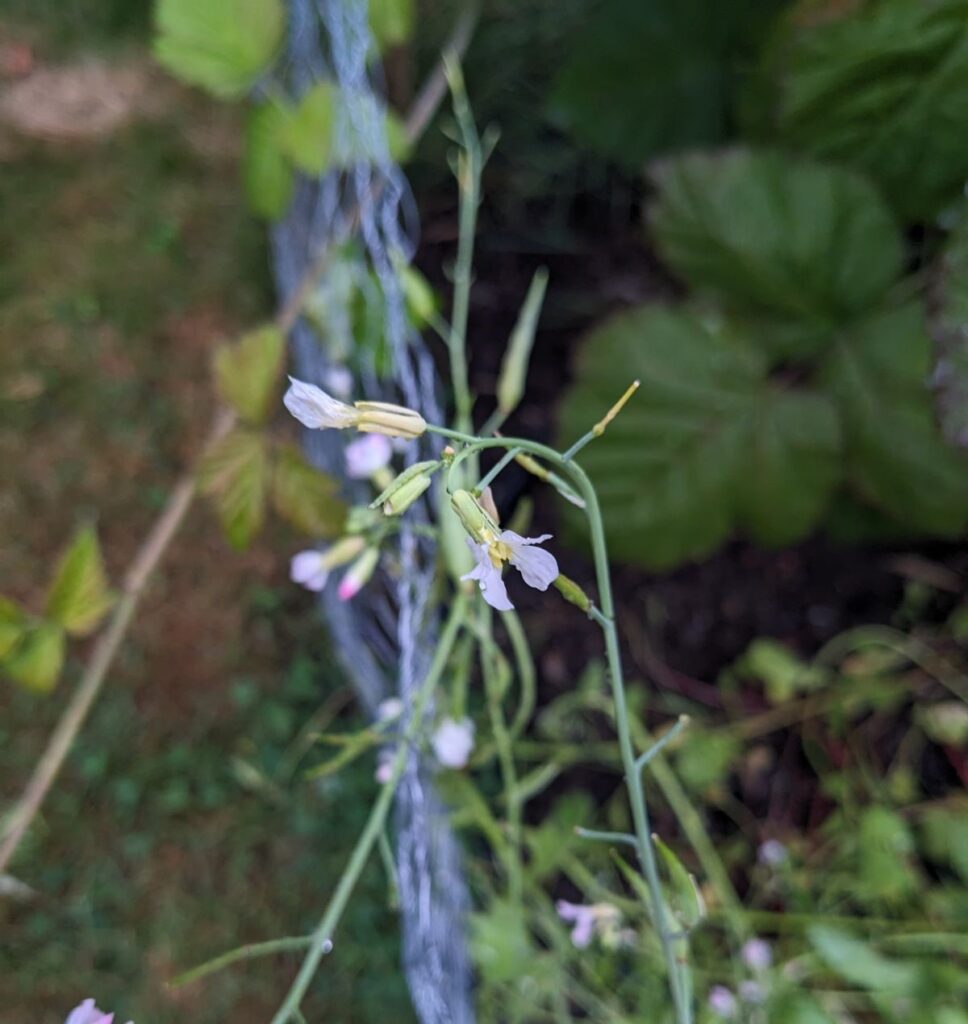
    I had one packet that did grow, but not enough for me to tell what it was. It got really leggy and went to flower pretty quickly.

    Radish Flowers (edible)

    The other day, I noticed that it was developing seed pods and realized it had been radish seeds. NO radishes grew though, just the greens (and very puny greens at that).

    Once I realized what it was, I went to Pinterest to see what kind of recipes there are for these.

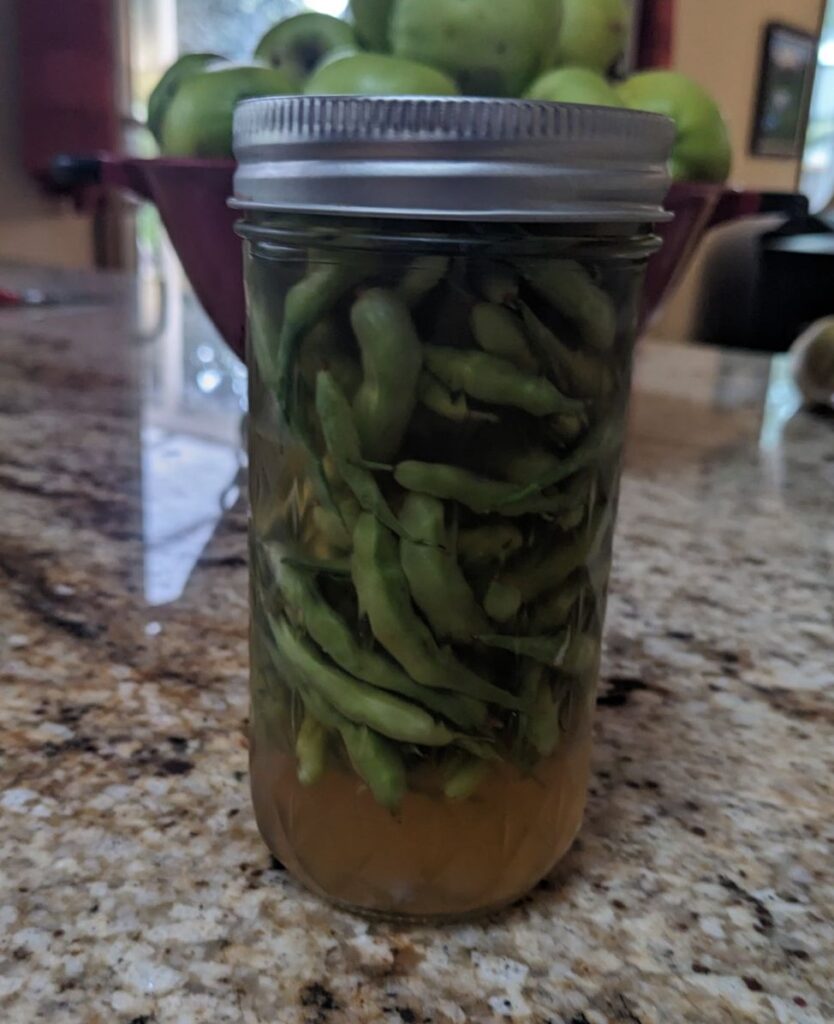
    Most of what I found are for seed pod pickles. So yesterday, I harvested pods and made a half of a batch of radish seed pods pickles. From what I’ve read, everything in this plant will have the bit of spice that a radish does.

    Radish Seed Pod Pickles (edible? I’ll see tomorrow!!)

    I’ll let them sit in the brine for a couple of days to really get good and pickled and then I’ll try them.

    Some of the pods will also be left in the garden to dry up and I’ll harvest those to use to seed new radishes next year.

    Apparently, the entire radish plant is edible. I think I’ll stick to the bulbs and if these pods turn out tasty, I’ll eat those too. The flowers, stems and roots can stay where they are.

  • Tea Towels

    (This post contains affiliate links which means if you purchase something through this link, I’ll make a few cents)

    I started a new hobby this past winter and have continued as I wait for spring and all of the outdoor activities to begin – embroidery. Now that the outdoor activities have begun, I’ve set this aside for now, but am enjoying using these tea towels.

    Embroidery is a quick, easy thing to occupy my hands in the evenings while watching TV. 

    When I was younger, I did counted cross-stitch and because of having that experience, it helped make embroidery much easier to pick up.

    I picked up some embroidery books from the library for ideas, have hand drawn a couple of the patterns and use quilt patterns (something like these) to draw on the towels. 

    Here’s how I did it:
    1) Start with a laundered cotton or linen towel.

    2) Using a washable pen or pencil (I have a couple specific for quilting and used those), draw a pattern onto the towel. If you’re using a pattern from a book, you’ll have to place the pattern under the towel and then trace it thru the fabric. (If you can tape it up to a window or have a light box, that would make things a LOT easier). If you’re using a quilting pattern, set it on top of the towel and draw the pattern on the fabric. 

    3) Start stitching.

    For the books I got from the library, I took a picture of the instructions page so I could reference back to it after I’d returned the book. That also worked great in taking some embroidery on vacation and packing just needles, thread, small scissors, hoop and towel. 

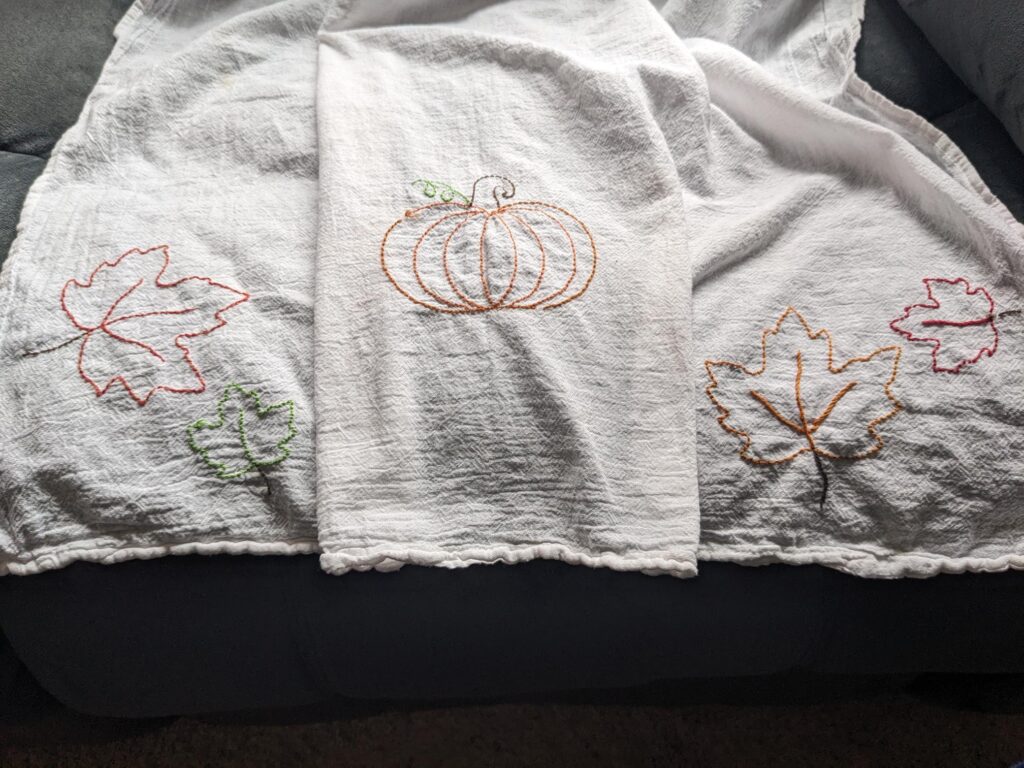
    Here are a few of the towels I’ve finished: 

    Butterfly, dandelion and dragonfly
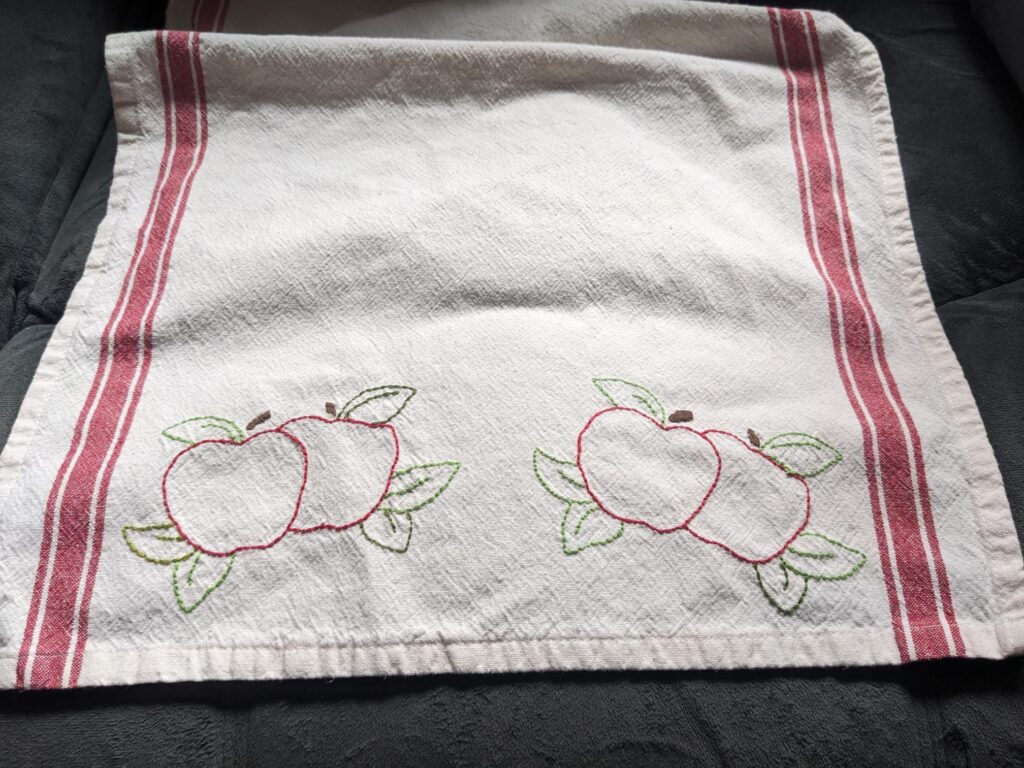
    Apples
    Fall leaves and pumpkin

    I have a few ideas for future towels, but I also need to have somewhere to use them 😉

    Happy crafting!

  • Strawberries

    (This post contains affiliate links which means if you purchase from my link, I will make a few cents)

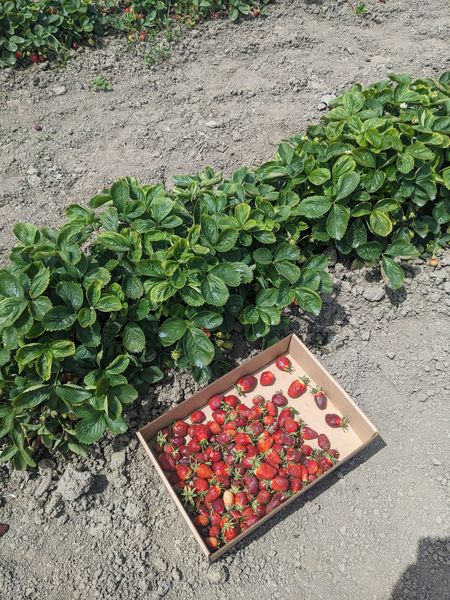
    It’s strawberry season here in the PNW. I’m very thankful for a u-pick farm nearby that has a variety of things I can pick. While they aren’t certified organic, they practice clean farming practices which we appreciate. 

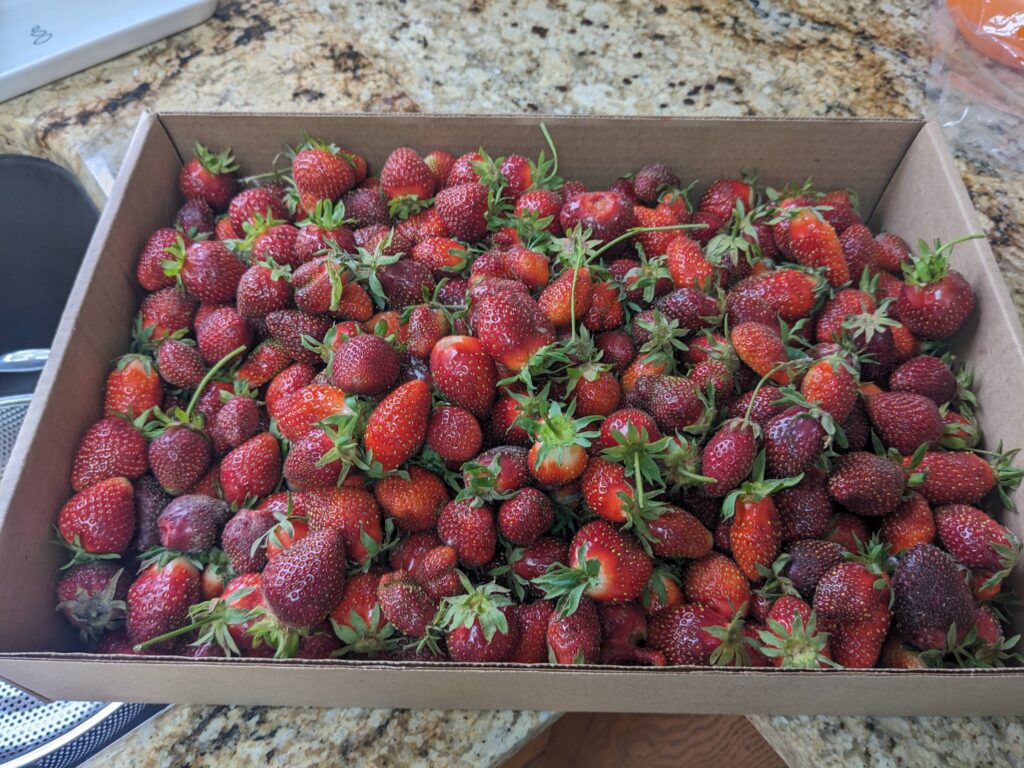
    I picked about 8ish pounds and brought them home, cleaned them up, sorted them and got to thinking about all that I going to do with them. 

    First up, EAT them! Strawberries are do delicious. Growing up, I wouldn’t touch them! I’m so glad my tastebuds changed in adulthood, and I tried them again. 

    I sorted the berries and separated the ones that are the ripest. (Some are almost purple, they’re so dark red!!) We’ll eat those tonight or tomorrow morning and whatever is left of those will go into jam. 

    Next up, make jam! 😛 I use Pomona Pectin which is a no-sugar/low-sugar pectin and uses calcium to activate the pectin rather than sugar. I tend to use a bit of honey for just a hint of sweetness (½ cup for the whole batch of jam). 

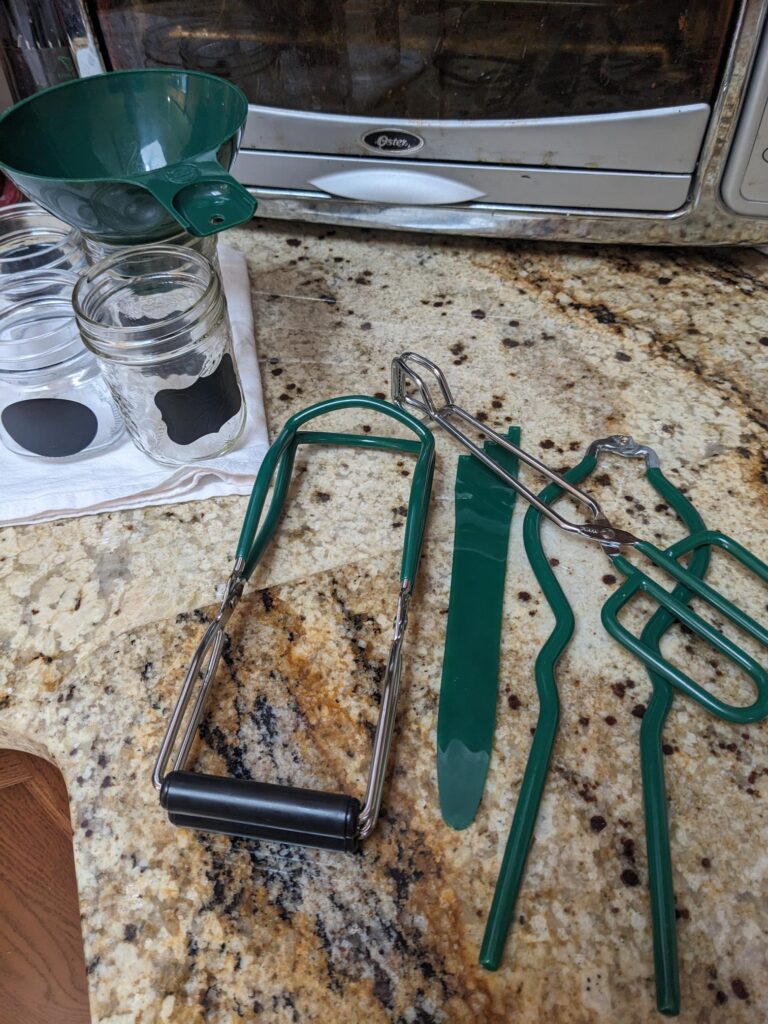
    I love this set of canning tools (see picture below) which helps when it comes to not burning fingers on boiling hot items!! You’ll also need canning jars. You can buy brand new with lids & rings. Or you can buy the jars, rings and lids all separate.

    Every time I can, I LOVE that ping of the jar sealing when it comes out of the water bath. I took a video and you can hear the ping, but it’s more of a ‘pong’ because the phone must have been a bit too close. LOL

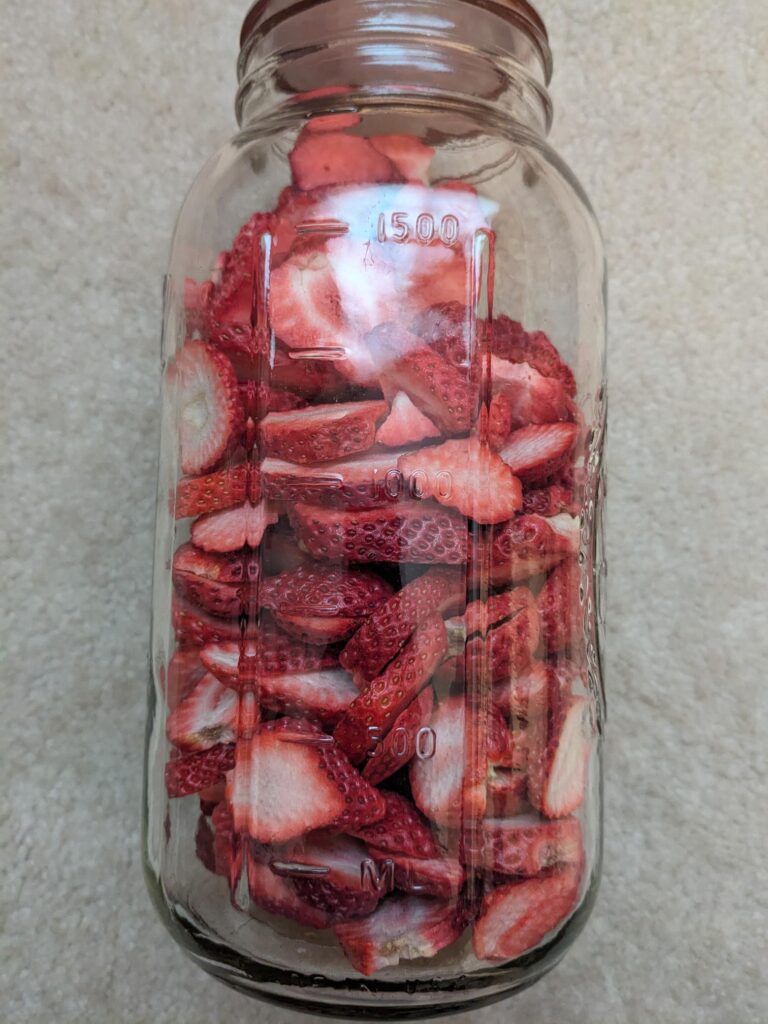
    Third way to use them, freeze dry them. As I’ve previously posted, we have a Harvest Right freeze-dryer which I use to make shelf-stable, dried foods that are ultra-lightweight for backpacking. Freeze dried strawberries are delicious. They work great to break up and throw into oatmeal but are also great to eat by themselves as a snack. I love having freeze dried fruit on hand. 

    (I store a lot of my freeze-dried food in mason jars as I’m not doing this for long-term storage. There’s less waste with not throwing out a mylar bag every time I need to repackage something to take backpacking. I love these half-gallon mason jars! I use these jar sealers that I use with our Foodsaver accessory vacuum sealer)

    Lastly, I’ll freeze some that we can use in smoothies or other things throughout the winter. (Nothing like a taste of summer in the cold of winter.) Last year, we bought a stand-up deep freeze that we keep in the garage. I have loved having fruits, vegetables and meat in the freeze to ‘shop’ from when it’s time to think about what to make for meals. I have one bag of raspberries left from last year and about a half bag of diced apples from last season. 

    As it is still early in strawberry season, I’m sure I’ll go out to the u-pick farm at least once more. (The farm has about 7 varieties of strawberries and only the first two were ripe when I went today.) 

    Happy Strawberry season!

  • Raspberry Rhubarb Jam

    Rhubarb – how I love thee and how I hate thee!!!

    Rhubarb causes so much excitement because it’s the first thing to harvest in the spring which means it is almost the start of gardening season. (Here in the Pacific Northwest, that season starts late and ends quick!!!)

    I also hate rhubarb – what in the world do I do with it all????

    Rhubarb isn’t one of those veggies that you just take a big ole stick and munch on all day. There’s the usual Strawberry Rhubarb pie, jam, scones, cakes, etc., rhubarb sauce (think applesauce but with rhubarb) and……what else????

    Last year, I made strawberry rhubarb jam. It’s yummy, but it turned out to be my least favorite of the jams I made, and the color is rather unappetizing. (Strawberries lose their color when you cook them, so the jam is a lovely shade of…brown.) I still have 2 small jars of it left from last year.

    Earlier this spring, while visiting a garden shop, I saw a jar labeled Raspberry Rhubarb Jam. Lightbulb moment!!! I have frozen raspberries that were given to me. And I have frozen rhubarb that I harvested and had no idea what to do with.

    The other day, while my husband was out mountain biking, (I tend to my messiest kitchen stuff while he’s not home) I decided it was the day to make the jam.

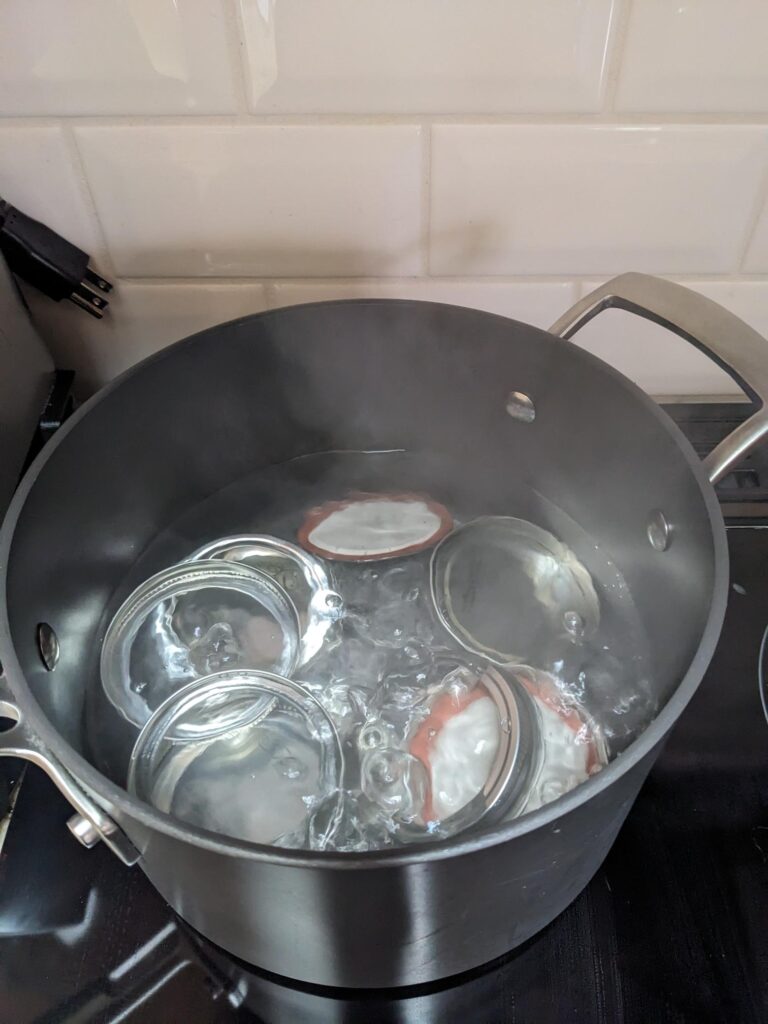
    Out came lots of pots and pans – the pot to cook the jam in, the pot to put jars in hot water while they were waiting and another pan to put the rings & lids in to boil while the jam was doing its thing. (Oh, I was also making a batch of pancakes for the freezer at the same time – the kitchen was A MESS!!!)

    Last year, I found Pomona Pectin which is a no/low sugar pectin that uses calcium and pectin to gel jams. (that is an affiliate link) I still use some honey in my jams, but no sugar! (I used 1 cup of honey for a double batch.)

    *Interesting tid bit – do you know the difference between jam and jelly? (I’ll tell you below)

    I followed the raspberry recipe in the pamphlet inside the Pomona Pectin box and doubled it. (Their recipe calls for 4 cups of berries and since I had both berries and rhubarb and 4 cups of each, I doubled the rest of the recipe)

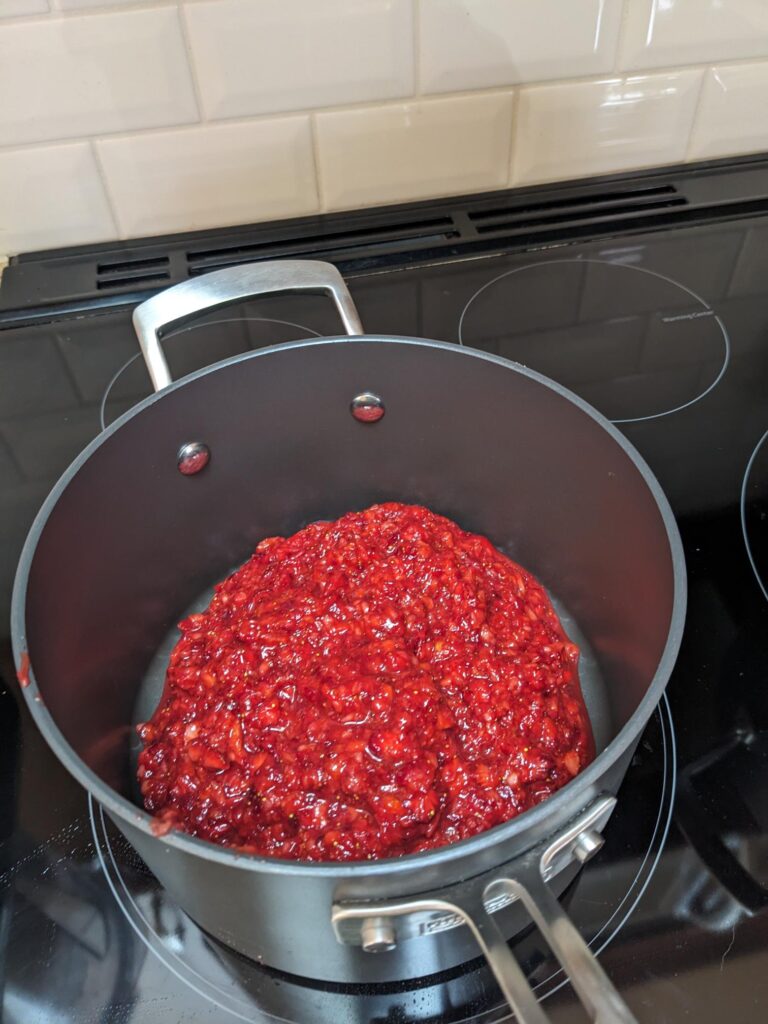
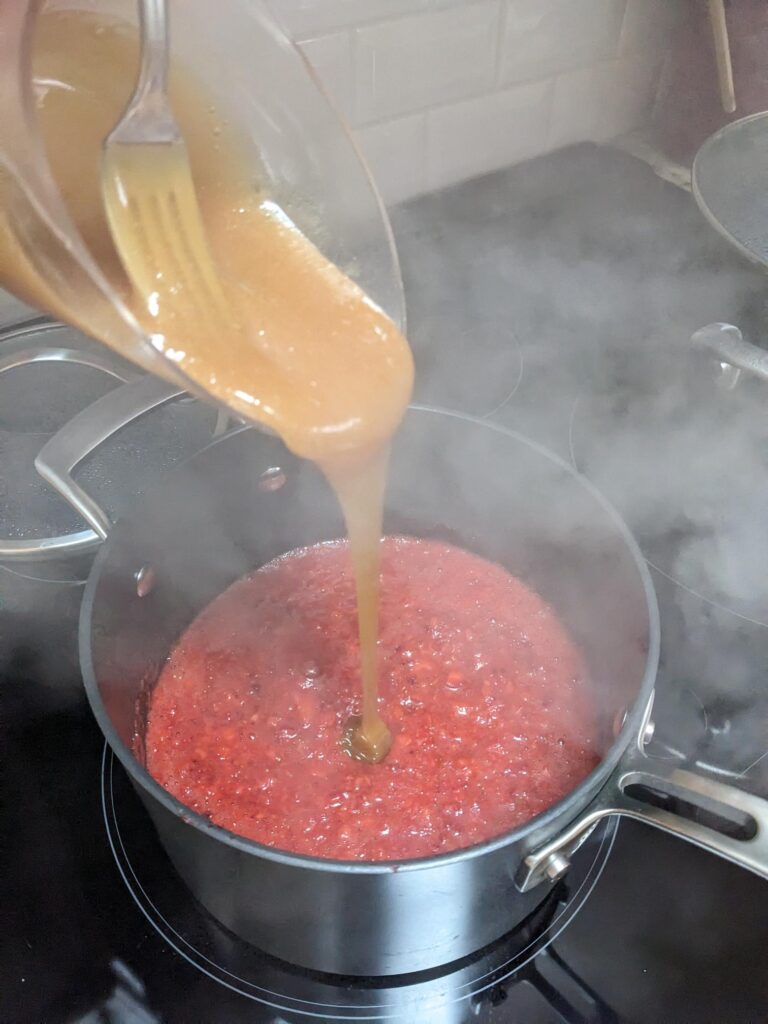
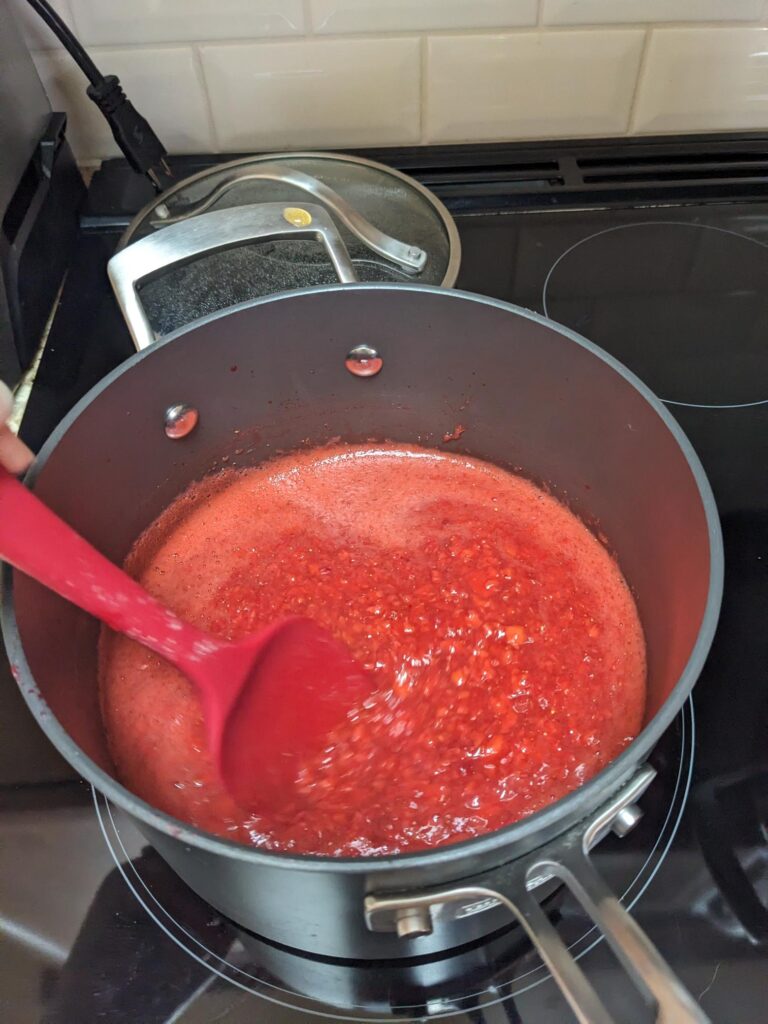
    I put the berries, rhubarb and calcium water into the pan and then mixed the pectin with the honey. I brought the fruit to a boil and then stirred in the honey and brought it all to a boil again.

    Time to fill the jars. I pulled the jars out of their hot water bath and put them on a towel on the counter (hot jars, cold granite counter – towels help!!).

    I ladled jam into the 6 jars I had out. The handy-dandy funnel helps keep things much cleaner. You need very clean jar edges to ensure a good seal and the funnel helps keep those edges clean. (That funnel comes in this canning set which is fantastic and helpful when dealing with VERY hot jars, contents, lids and rings!) (that is an affiliate link)

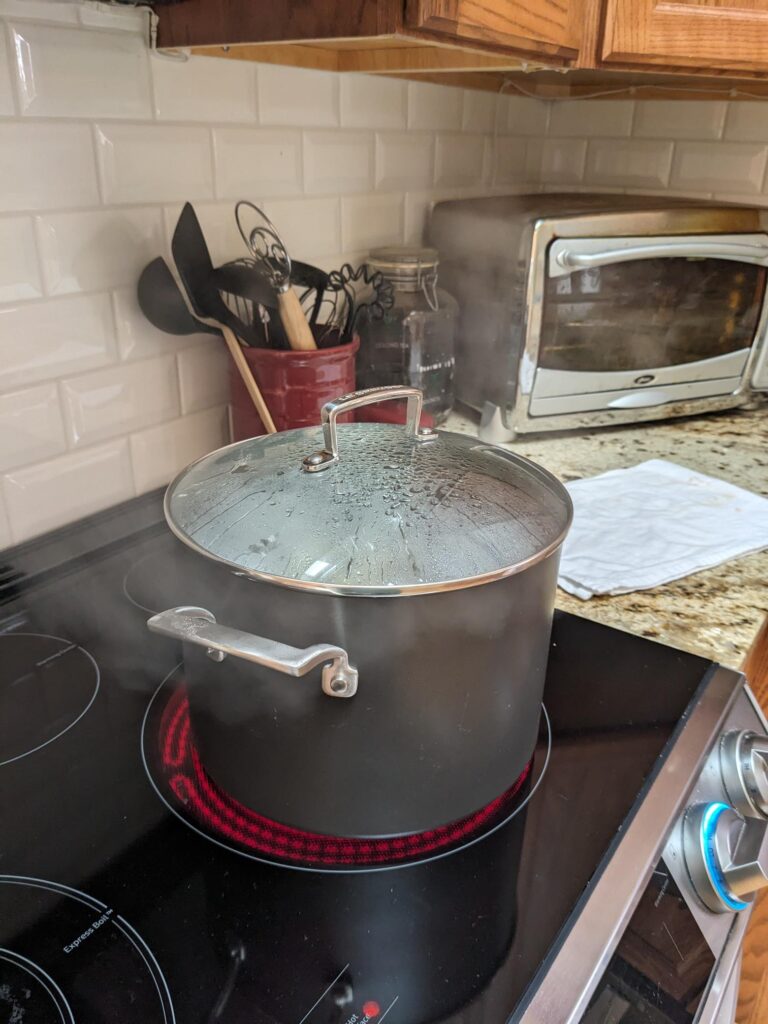
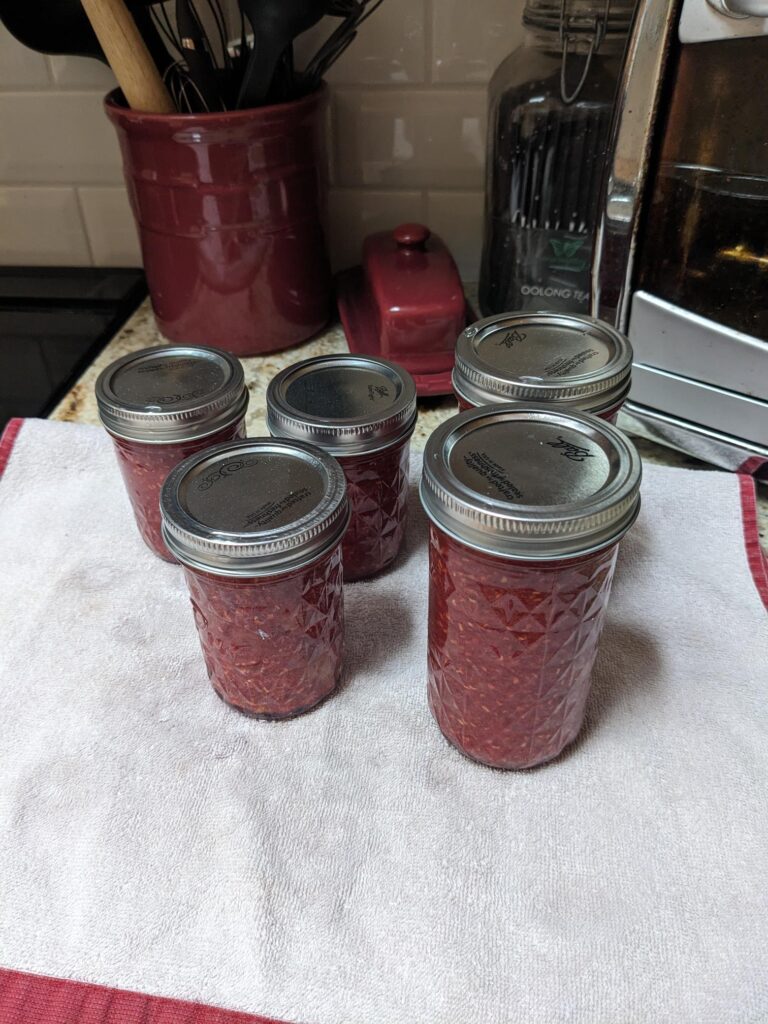
    The jam was now ready to get its water bath. Since I only had 5 full jelly jars (the 6th was only partial so I didn’t ‘can’ it, it went in the fridge to use right away), I cleaned out the pot I had made the jelly in, filled it with water, and brought that to a boil. Once it was boiling, the jars went in to boil for 10 minutes. (Please use proper canning procedure to ensure you don’t have spoilage. Ball has a great book on canning basics that is a fantastic resource to have on hand.)

    *tid bit – jam is made using the whole fruit, jelly is made using just the fruit juice

    When they finished their bath, they dried off on the towel on the counter. (again, hot jars, cold counter, good idea to have something to buffer between the two.) And I waited (not for very long) for that satisfying ‘ping’ that lids make when they seal. The first ping was before all of the jars were out of the pot!

    awaiting the ‘ping’

    I let the jars cool for a good 9+ hours before I moved them. I wanted to ensure everything was sealed well.

    After making the jam in the morning, I made a loaf of sourdough bread that evening and then had a slice of bread with the jam for lunch today. YUM!!! I think strawberry rhubarb is something in the past for my tastebuds. The raspberry rhubarb combo is DELICIOUS!!!

  • Stores! Who needs ’em?

    (I still do for a LOT, but that list is beginning to shrink)

    Since I retired, I have taken on a sense of frugality that is up a notch or two from my past level of frugality. I now look at just about everything we buy and bring into the house to see if there is a way to make it myself and not need to buy it from stores.

    Someone asked me not too long ago if I was a prepper because apparently this pursuit makes me rather ‘granola’. LOL, No, I’m not a prepper. I’m more of a preparer.

    I grew up out in the country and we were snowed in just about every year and had summer storms that made us lose power or even kept us home with trees down over the driveway. Being prepared is just in me!

    I also like the idea of being more sustainable and not throwing things away that I spent good money on. For some of the things I’m working on and intend to make for myself in the future, I am also looking at what kind of chemicals are in the storebought stuff and in making it myself, can I get a ‘cleaner’, non-toxic product?

    Bathroom swaps:

    So far, I have made make-up removers using cotton and flannel that I had in my material stash. They’re not pretty but they work great. (I’ll make nicer ones in the future or deconstruct these sometime and redo them with a more finished look) They’re simple two-sided squares with the cotton (cute) pattern on one side and the flannel (soft) side on the other. I use those to replace cotton balls and throw them in the wash and reuse. (I’ve obviously used the ones in the picture and will keep the flannel color in mind for the future when I make more. The flannel will get stained from the mascara)

    I used to use cosmetic sponges to apply foundation and switched to a reuseable one that I can wash between uses. I’m still getting used to this one, but I like not shopping for cosmetic sponges anymore!

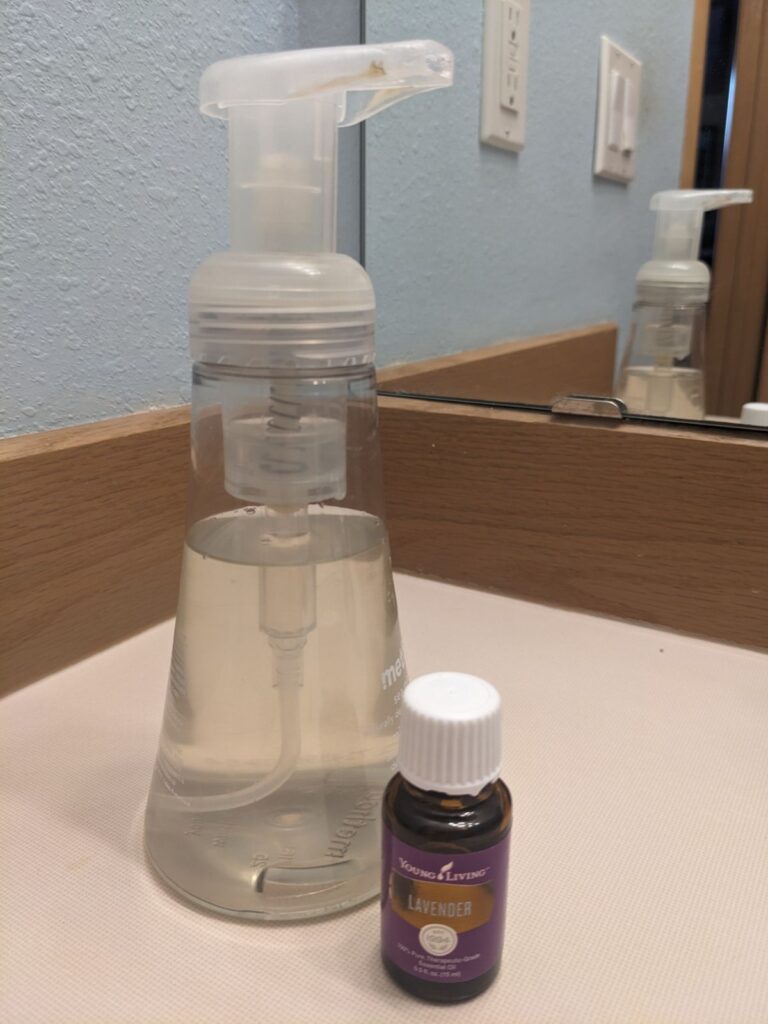
    Just the other day, I made my first batch of foaming hand soap. It was SO simple! (Castile soap, water and essential oil for scent). I refilled two bottles and so far, I love this soap. I’m looking forward to future refills and being able to play with the scents.

    Kitchen swaps:

    Most of these are on my to-do list and haven’t been done yet. But, I bought some flannels yardage to make reuseable paper towels. I’ll also use this material to make some Swiffer pads. All of these will be able to be washed in the laundry and reused over and over.

    I have started making sourdough bread. This has been a learning curve, but I have stopped buying “THM on-plan” store-bought bread (sprouted bread). I’m still working out how to consistently get a good sandwich loaf. Some have been great, others, not.

    I have started doing some fermenting with making kefir, kombucha and apple cider vinegar. These items store-bought are expensive, but SO incredibly simple to make at home. Kefir uses “grains” that eat the stuff in milk turning it into really good bugs for gut health. Kombucha uses a SCOBY (symbiotic culture of bacteria and yeast) which ‘eats’ the sugar in sweet tea and turns it into a yummy drink that replaces pop and again, gives me good gut bacteria. And apple cider vinegar is so useful in the kitchen and delicious! This uses apple scraps and grows a ‘mother’. (yes, this is all VERY ‘granola’)

    This is a continuing process and I keep thinking about what to make or try to get away from buying from the store. I think dishwasher tabs and liquid dish soap make be next on my list to make.
  • Garden 2024 – the start

    I’ve started gardening for 2024! Yep, you read me right, I have started gardening.

    We have a large variety of seeds, but I think many are so old they’re no longer viable. The only way to find out is to plant them, give them time and see what happens.

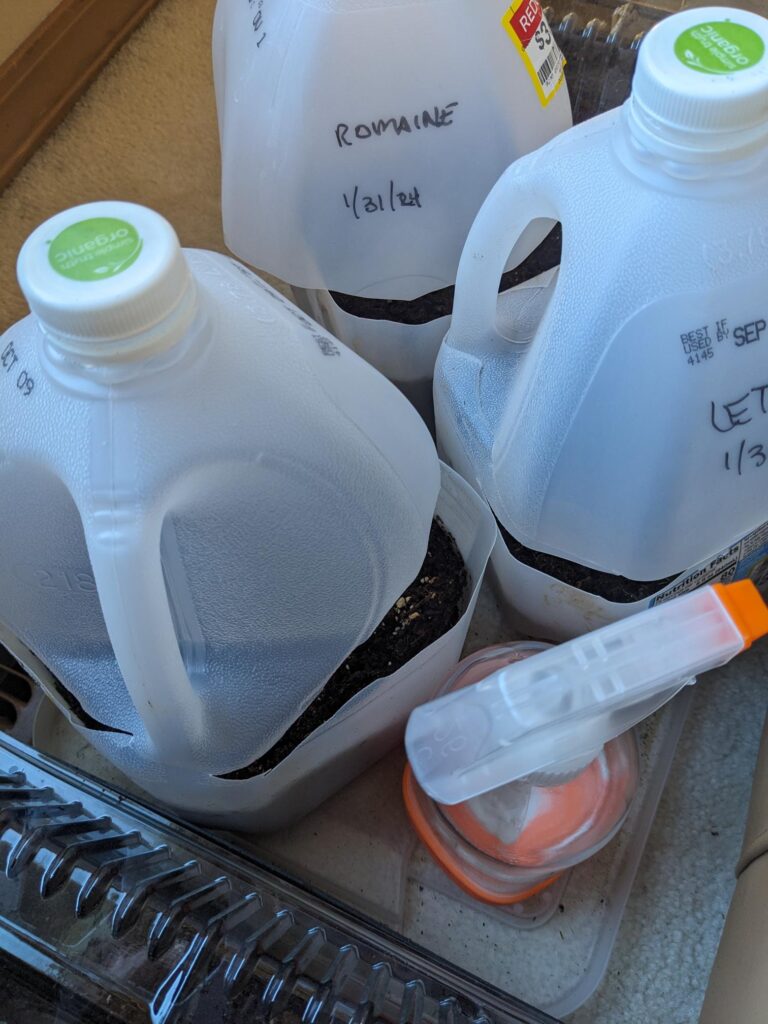
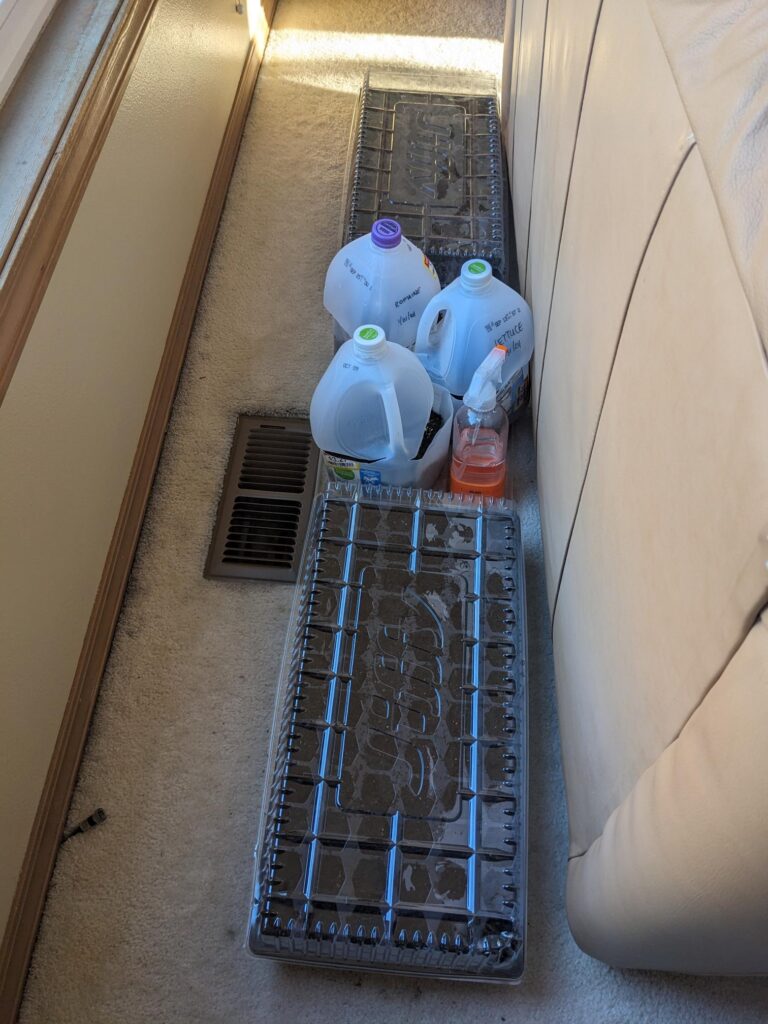
    On January 31st, I planted 3 different lettuces in milk jugs. 2 weeks later, nada. I’m not giving up yet!

    Next up, February 12th, I planted what need to be started inside – peppers, tomatoes, broccoli, cauliflower, parsley and marigolds. I have two flats and three more milk jugs.

    If these seeds aren’t viable and don’t sprout up, then I’ll plant more in another week or so or buy starts from a local blogger I found last year who is in my USDA zone.

    I’ve marking my labels with the seed packet I’m using (brand, not just what the seed is). If they don’t sprout, I’ll throw that packet away.

    After last year’s rather first attempt at a garden, we have amended the soil. Last year, we planted in dirt and hoped for the best. This year, we started in the fall by adding a couple of inches of fertile mulch, grass clippings and a light layer of leaves. Last month, I turned that over and raked it in together to help break up what had matted down. I will get more compost added to the garden before I start planting outside.

    My goal for my 2023 garden was 50 pounds harvested and ended up with almost 100 pounds from the back yard. (Thankfully my husband had several types of berry plants planted years ago and a couple of apple trees.) My 2024 garden goal hasn’t fully been decided yet, but it will be over 100 pounds.

    I’m happy to get to play in the dirt already!

  • Soap Making

    Learning New Skills – Soap Making 

    After a rough tiring week at work, I took Friday afternoon off. (Truth be told, my ‘afternoon’ started at 10:30AM that day.)  I headed to my friend A’s house to do some soap making.  When I got there, her daughter dutifully told me that “daddy prayed that nothing will explode.”  Ha ha!  A’s husb& was home & he said in his defense, “I was laughing when I prayed that.”  (I’m glad he did!  – both pray for us & laugh!) J 

    A had gone out & purchased all the ingredients needed ahead of time so when I arrived, we were ready to get started.  But, before we did, A & I sat down & read through all of the instructions on how to make the soap.  Then we headed to the kitchen. 

    A covered the counter with butcher paper & pulled out all the ingredients we would be working with.  She determined which pitcher to use to mix the water & lye & marked it so her family wouldn’t use it again in the figure. 
    We started by mixing the water & lye.  This was where we prayed ourselves that nothing would explode.  Thankfully, their house is 100% intact with no damage done.  There was an odor that was pretty harsh when inhaled, but we opened the kitchen window & door then turned on the exhaust fan.  The odor didn’t last long. 

    While we waited for the water/lye mixture to cool off, we measured out & weighed the other ingredients.  We used Olive Oil, Coconut Oil, Castor Oil & later added the lemon essential oil.  The oils went into a pot on the stove which was turned low to melt the coconut oil.  By the time we were finished getting all of the oils measured & into a pot, the water/lye mixture had cooled to about the same temperature as the oils. 

    We then cautiously poured the water/lye into the oils pot & got the immersion blender going.  We fully submerged it & I started it on low.  I blended & blended & blended.  The mixture started to look like pudding (DON’T EAT IT!) & kept going until it was thick enough that we got ‘trails’ as we moved the blender through it. 

    Once we had trails, we added the lemon essential oil.  We poured it in on top & then started up the blender again to get it all incorporated in. 

    Once we had deliciously smelling liquid pudding-like soap, we slowly poured it into paper cartons.  A had cartons cleaned ahead of time to use as the forms.  (Remember making c&les in kindergarten using the school milk cartons? – ok, maybe I just aged myself.)  I held the pot up & A scraped the mixture into 2 of the forms. 

    She decided ahead of time that she wanted to try lemon poppy seed for one of the forms, so we stopped & put the pot down.  She added the poppy seeds & we mixed it all together again.  We then poured the mixture into the final form. 

    I lifted & dropped all of the forms (ok, so actually one or two at a time, not all at once) against the countertop to work any air bubbles out before it set. 

    Now, we wait.  A moved the forms out of her kitchen so they could set for a day.  They are still caustic for 24 hours.  & Saturday, she’ll take them out of the forms & cut them.  We’re hoping to get 24 small bars from this batch.  Once they’re cut, they will cure for 3 weeks before we’ll use them. 

    I’ll provide an update once they’ve been cured. 

    We both decided this was not something to be afraid of doing & was much easier.  We were also very happy to try it for the first time with a friend & not alone. J (What isn’t better with a friend?) 

    The recipe & instructions we used came from Little House in the Suburbs by Deanna Caswell & Daisy Siskins.